Paying extra on a loan can reduce interest and help you become debt-free sooner. The difficult part is deciding how much extra to pay.
There is no universal amount that works for every borrower. An extra $25 may create meaningful savings on one loan and barely change another. The result depends on the current balance, interest rate, monthly payment, remaining term, loan structure, and how much financial flexibility the borrower needs to preserve.
For many borrowers, a useful extra payment is the smallest sustainable increase that captures a meaningful share of the available interest savings without placing unnecessary pressure on monthly cash flow.
That amount is not always the largest payment you can afford. It is also not necessarily a round number such as $50 or $100.
Article details
Author: Fynia Research Team
Published: July 15, 2026
Last reviewed: July 15, 2026
Methodology note: Calculations for this example were generated with Fynia's amortization and payment-optimization model and manually audited against the detailed amortization schedules in the accompanying report.
The answer in one paragraph
Compare several payment levels rather than choosing an arbitrary extra amount. Look for the point where increasing the monthly payment still creates meaningful interest savings and payoff acceleration, but additional dollars begin producing smaller relative improvements. Then compare that mathematically efficient range with your emergency savings, other debts, income stability, and personal preference for becoming debt-free sooner.
In the detailed example in this guide, increasing a $450 monthly payment to approximately $511 produces the strongest modeled balance between payment growth and interest reduction. Paying less still produces meaningful savings, while paying more creates a faster payoff but lower relative efficiency.
There is no universal "right" extra payment
Common rules include:
- Pay an extra $100 each month.
- Increase the payment by 10%.
- Round the payment up to the next $50 or $100.
- Make one additional payment each year.
- Pay as much as possible.
These rules can be useful starting points, but they do not account for the characteristics of a specific loan.
An additional $100 will not have the same effect on:
- a $10,000 auto loan at 8%;
- a $20,000 personal loan at 12%;
- a $100,000 installment loan at 5%;
- a $400,000 mortgage at 7%.
The remaining repayment period matters as well. On an amortizing loan, each payment is divided between interest and principal. Early in the repayment schedule, the balance is usually higher, so a larger portion of the payment commonly goes toward interest. As principal declines, the interest portion generally falls. That is part of how loan amortization works.
The better question is therefore not simply:
How much extra can I pay?
It is:
Which sustainable payment gives me the combination of interest savings, faster payoff, and monthly flexibility that best matches my priorities?
Why most extra-payment calculators do not fully answer the question
Most traditional extra-payment calculators ask you to enter an additional amount first.
You might enter:
- $25 extra;
- $50 extra;
- $100 extra;
- one annual lump sum.
The calculator then shows what happens.
That approach answers:
What will happen if I pay this amount?
It does not necessarily answer:
Which extra-payment amounts should I compare in the first place?
Fynia reverses that process. Instead of requiring the borrower to guess an extra amount, the model evaluates multiple possible payoff terms, calculates the payment associated with each one, and compares the resulting alternatives.
The goal is not to claim that one payment is universally perfect. It is to identify a practical range that lets the borrower compare:
- affordability;
- interest reduction;
- payoff speed;
- diminishing relative efficiency;
- total repayment;
- the final payoff date.
This is the main difference between a standard payoff calculator and a loan payoff optimizer.
What happens when you pay extra on a loan?
On a typical simple-interest amortizing loan, how loan interest works depends on the outstanding balance.
When an additional payment reduces principal:
- The outstanding balance becomes smaller.
- Future interest is calculated on that smaller balance.
- More of later payments can go toward principal.
- The loan may be repaid sooner.
- Total interest may decline.
The CFPB explains that paying principal down more quickly can reduce the interest owed on an auto loan. It also notes that mortgage interest generally declines as the principal balance falls.
However, the exact result depends on the contract and how the servicer processes the money.
Fees, accrued interest, principal treatment, and paid-ahead status can change the result shown on the next statement. Review how extra loan payments are applied and verify the posted transaction before relying on a principal-only projection.
If you want the core mechanics behind those savings first, read how extra payments reduce interest.
Why the largest payment is not always the most efficient
A larger monthly payment will usually produce greater absolute savings on a typical eligible amortizing loan.
But the largest savings and the greatest relative efficiency are different objectives.
Consider two hypothetical alternatives:
- Paying $25 extra saves $492.
- Paying $136 extra saves $1,996.
The second alternative clearly saves more dollars and repays the loan faster.
But it also requires more than five times as much additional monthly cash.
This creates two distinct questions.
Maximum savings
Which payment produces the lowest total interest among the alternatives being considered?
Maximum modeled efficiency
Which payment produces the strongest relative benefit compared with the increase in monthly payment?
As the payment grows, the loan continues to end sooner, but there is progressively less future interest left to eliminate. Within Fynia's comparison framework, the resulting curve can reveal a peak after which larger payments continue saving money but generate lower relative efficiency.
A payment beyond that peak may still be appropriate. It simply prioritizes faster payoff and larger absolute savings over remaining at the highest point of the model's efficiency curve.
How to measure the payment trade-off
Fynia begins by comparing two percentage changes.
Payment Increase
Payment Increase measures how much the proposed payment rises relative to the current payment.
Payment Increase % =
(New Payment - Current Payment)
÷ Current Payment
× 100
Interest Reduction
Interest Reduction measures how much estimated remaining interest is eliminated relative to the baseline repayment plan.
Interest Reduction % =
(Baseline Interest - New Interest)
÷ Baseline Interest
× 100
Efficiency Ratio
Fynia compares the two percentage changes using an Efficiency Ratio.
Efficiency Ratio =
Interest Reduction % - Payment Increase %
For example, increasing a monthly payment from $450 to $511 gives:
(511 - 450) ÷ 450 × 100 ≈ 13.6%
If estimated interest falls from approximately $6,583 to $5,502:
(6,583 - 5,502) ÷ 6,583 × 100 ≈ 16.4%
Using the underlying unrounded values in this example, the result is approximately:
2.9 percentage points
A positive result means the percentage reduction in estimated interest is greater than the percentage increase in the monthly payment.
A larger positive gap indicates that the payment is producing comparatively strong interest savings relative to its size.
Important
Fynia's Efficiency Ratio is a proprietary comparison metric designed to rank alternatives within the same loan. It compares two percentage changes that use different reference values. It should not be interpreted as an investment return, APR, guaranteed benefit, credit-industry standard, or universal measure of financial suitability.
A positive Efficiency Ratio does not by itself mean that a payment is affordable or preferable to maintaining emergency savings, repaying another debt, receiving an employer retirement match, investing, or preserving liquidity.
Payment Efficiency
Fynia evaluates all modeled payment alternatives and identifies the point with the highest Efficiency Ratio.
That alternative becomes Ideal and is assigned a Payment Efficiency of 100%.
The other alternatives are measured relative to that peak.
Payment Efficiency therefore answers:
How close is this payment alternative to the most efficient point found for this particular loan?
It does not answer:
Is this payment personally affordable or financially superior to every other use of the borrower's money?
How Fynia evaluates possible monthly payments
Fynia does not test only arbitrary increases such as $25, $50, or $100.
Instead, the model evaluates one theoretical payment for each possible whole-month payoff term before the baseline payoff date.
Suppose the existing payment would repay a loan in 60 months. The model evaluates the decimal payment theoretically required to repay it in:
- 59 months;
- 58 months;
- 57 months;
- and so on.
For each term, the model:
- Calculates the theoretical decimal payment.
- Generates an exact amortization schedule.
- Calculates total interest and interest savings.
- Measures Payment Increase.
- Calculates Efficiency Ratio.
- Normalizes the alternatives into Payment Efficiency.
- Identifies representative alternatives on both sides of the efficiency peak.
The representative alternatives are selected as follows:
- Basic: the alternative before Ideal whose efficiency is closest to 70%.
- Standard: the alternative before Ideal whose efficiency is closest to 80%.
- Premium: the alternative before Ideal whose efficiency is closest to 90%.
- Ideal: the maximum-efficiency alternative.
- Quick: the alternative after Ideal whose efficiency is closest to 90%.
- Max: the highest modeled payment that still retains a positive Efficiency Ratio before final whole-dollar rounding.
After an alternative is selected, its theoretical decimal payment is rounded upward to a whole dollar. Fynia then recalculates:
- the amortization schedule;
- total interest;
- payoff term;
- final payment;
- payoff date;
- visible Efficiency Ratio;
- visible Payment Efficiency.
Because of that final rounding and recalculation, an alternative selected as the closest available point to 70%, 80%, or 90% may display a different final percentage.
If you want the loan-type version of this comparison, you can also compare extra auto-loan payment options.
Scope of the example
The following case models a:
- fixed-rate loan;
- fully amortizing repayment structure;
- constant monthly interest rate;
- regular monthly payment schedule;
- loan with no recurring fees;
- loan with no modeled prepayment penalty;
- loan in which excess payments reduce the modeled balance.
The results may not apply in the same way to:
- revolving credit cards;
- adjustable-rate loans;
- interest-only loans;
- balloon loans;
- precomputed-interest loans;
- subsidized loans;
- loans with forgiveness or repayment-assistance benefits;
- loans with payment-allocation restrictions.
Precomputed-interest auto loans require particular caution. The CFPB explains that making additional payments on this type of contract may not reduce principal or interest in the same way as a typical simple-interest loan.
Example: How much extra should you pay on a $20,000 loan?
Consider this loan:
| Loan input | Value |
|---|---|
| Current balance | $20,000 |
| Annual interest rate | 12% |
| Current monthly payment | $450 |
| Monthly fees | $0 |
| First modeled payment | August 2026 |
Baseline repayment
If the borrower continues paying $450 per month:
| Baseline result | Value |
|---|---|
| Regular monthly payment | $450 |
| Remaining term | 60 months |
| Estimated remaining interest | $6,583 |
| Estimated total repayment | $26,583 |
| Final payment | Approximately $33 |
| Estimated final payment date | August 2031 |
The final payment is much smaller than the normal $450 installment because only the remaining principal and the final period's interest need to be paid.
Comparing the payment alternatives
| Alternative | Monthly payment | Extra per month | Interest remaining | Interest saved | Remaining term | Time saved | Payment Efficiency |
|---|---|---|---|---|---|---|---|
| Baseline | $450 | - | $6,583 | - | 5y 0m | - | - |
| Basic | $475 | $25 | $6,091 | $492 | 4y 7m | 5 months | 67.1% |
| Standard | $482 | $32 | $5,966 | $616 | 4y 6m | 6 months | 78.7% |
| Premium | $488 | $38 | $5,863 | $719 | 4y 5m | 7 months | 86.7% |
| Ideal | $511 | $61 | $5,502 | $1,081 | 4y 2m | 10 months | 100.0% |
| Quick | $536 | $86 | $5,158 | $1,425 | 3y 11m | 13 months | 88.7% |
| Max | $586 | $136 | $4,587 | $1,996 | 3y 6m | 18 months | 3.4% |
The calculations use exact amortization schedules and adjusted final payments rather than assuming that every installment equals the regular monthly amount.
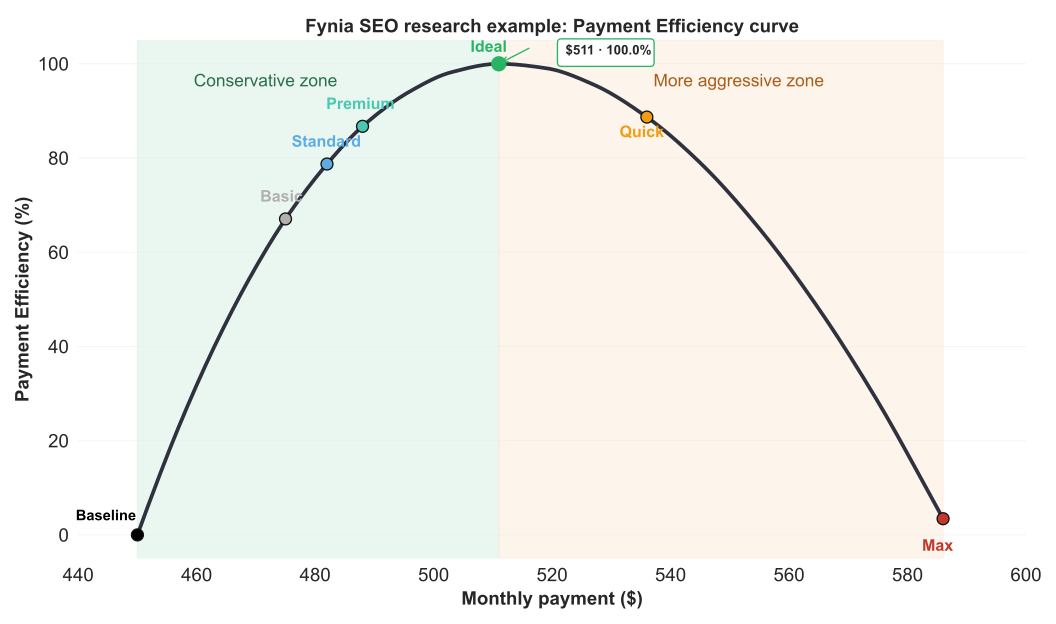
The modeled efficiency curve peaks at the $511 Ideal payment. Larger payments continue reducing interest and payoff time but produce lower relative efficiency.
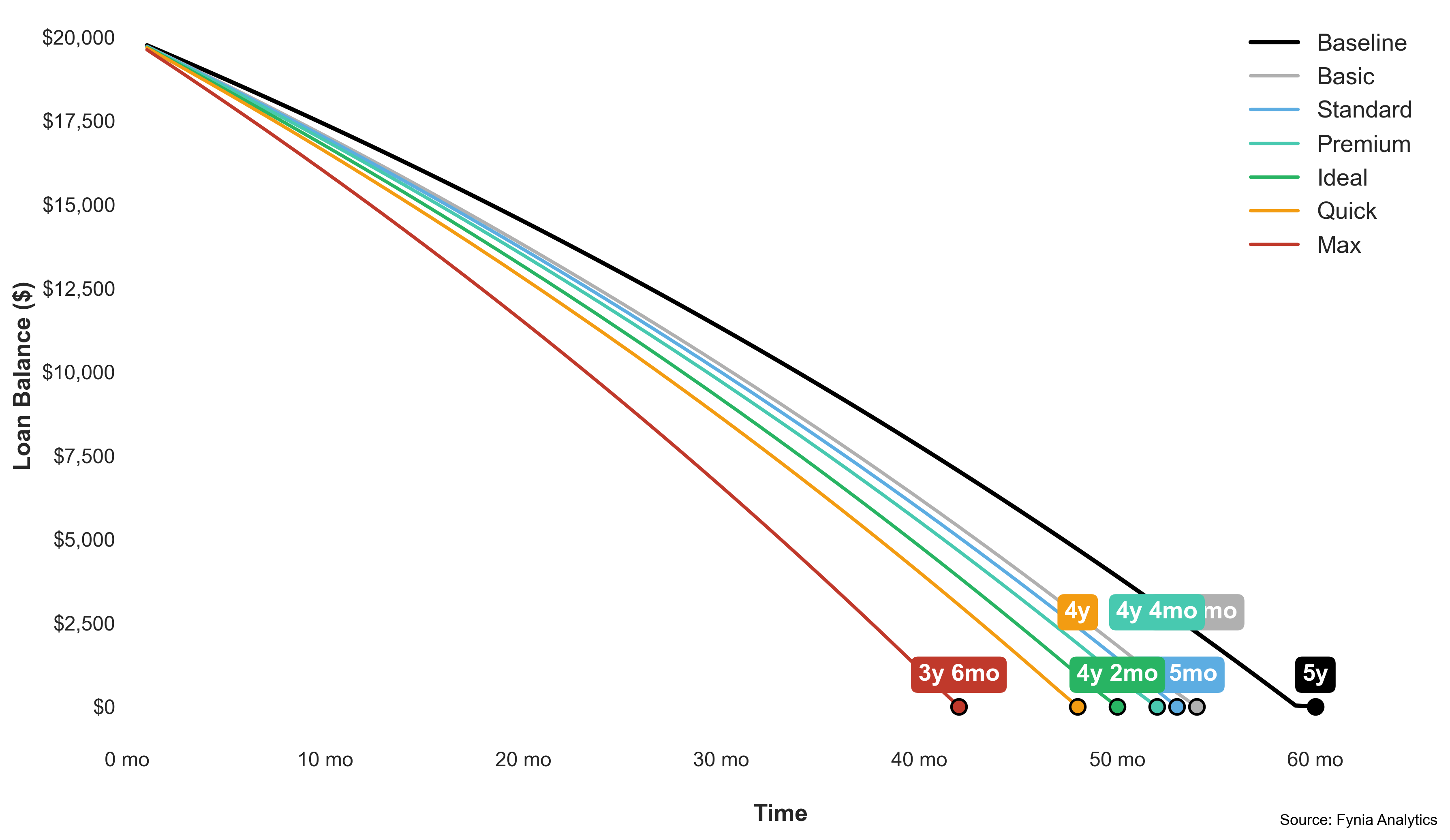
Each higher payment reduces the balance faster, shortening the repayment period from five years under Baseline to three years and six months under Max.
What each payment option means
Basic: $25 extra per month
The Basic alternative increases the payment from $450 to $475.
That represents approximately:
- a 5.6% increase in monthly payment;
- a 7.5% reduction in remaining interest;
- $492 in estimated savings;
- five months removed from the repayment term.
Basic does not reach the highest point of the efficiency curve, but it produces measurable benefits with a relatively small monthly commitment.
It may be appropriate for a borrower who:
- has limited room in the budget;
- wants to begin conservatively;
- values flexibility;
- prefers a payment that is easier to sustain.
A small extra payment that can be repeated consistently may be more useful than a much larger payment that must be discontinued after a few months.
Standard: $32 extra per month
Standard raises the payment to $482.
Compared with the baseline, it produces approximately:
- $616 in interest savings;
- a six-month reduction in repayment time;
- 78.7% Payment Efficiency.
Standard requires only $7 more per month than Basic but saves roughly another $124 and removes approximately one additional month.
This is a practical middle option for borrowers who want a stronger result without making a large jump in their monthly commitment.
Premium: $38 extra per month
Premium increases the payment to $488.
The borrower would receive approximately:
- $719 in interest savings;
- a seven-month reduction in the repayment term;
- 86.7% Payment Efficiency.
Premium costs only $6 more per month than Standard and saves about another $103.
It sits closer to the efficiency peak while keeping the total increase below $40 per month.
Ideal: $61 extra per month
Ideal raises the payment from $450 to $511.
That is approximately a 13.6% increase in the regular payment.
In return, the modeled results include:
- approximately $1,081 in interest savings;
- a 16.4% reduction in remaining interest;
- a 10-month reduction in the repayment term;
- the highest Efficiency Ratio among the alternatives evaluated.
Ideal is therefore assigned a Payment Efficiency of 100%.
This does not mean that $511 is automatically affordable or personally appropriate. It means that, within this loan's modeled alternatives, it creates the strongest relative relationship between payment growth and interest reduction.
Quick: $86 extra per month
Quick raises the payment to $536.
Compared with Ideal, the borrower commits an additional $25 per month.
That produces approximately:
- $344 more interest savings than Ideal;
- a payoff about three months sooner;
- total estimated interest savings of $1,425.
Quick sits on the other side of the efficiency peak. Its Payment Efficiency falls to approximately 88.7%, even though it saves more money and repays the loan faster.
This alternative is designed for borrowers who value becoming debt-free sooner more than remaining at the highest relative-efficiency point.
Max: $136 extra per month
Max increases the payment to $586.
Among the displayed alternatives, it produces the greatest absolute benefit:
- approximately $1,996 in interest savings;
- an 18-month reduction in the repayment period;
- a payoff date around February 2030.
However, its Payment Efficiency is only approximately 3.4%.
The reason becomes clear when the percentage changes are compared:
| Max metric | Approximate result |
|---|---|
| Payment increase | 30.2% |
| Interest reduction | 30.3% |
| Displayed Efficiency Ratio | Approximately 0.0 pp |
The borrower still saves money and becomes debt-free much sooner. The issue is not that Max fails to help.
The issue is that the monthly payment has increased almost as much proportionally as the remaining interest has declined.
Max represents the upper modeled payment boundary before the underlying pre-rounding Efficiency Ratio becomes non-positive. Because the final payment is rounded to a whole dollar and recalculated, its displayed Efficiency Ratio can round to 0.0 percentage points even though the selected theoretical alternative remains slightly positive.
Compare the next step, not only each option against the baseline
A useful way to evaluate the alternatives is to compare each payment with the one immediately before it.
| Move | Additional monthly payment | Additional interest savings | Additional time saved |
|---|---|---|---|
| Basic -> Standard | +$7 | About $124 | About 1 month |
| Standard -> Premium | +$6 | About $103 | About 1 month |
| Premium -> Ideal | +$23 | About $362 | About 3 months |
| Ideal -> Quick | +$25 | About $344 | About 3 months |
| Quick -> Max | +$50 | About $571 | About 5 months |
These differences use the rounded figures displayed in the report, so exact values may differ slightly.
This incremental view helps answer questions such as:
Is moving from $511 to $536 worth another $25 every month in exchange for about $344 more savings and a payoff roughly three months earlier?
The answer depends on the borrower's priorities.
So, how much extra should you pay?
The example supports three broad decision ranges.
Choose a conservative increase when flexibility matters most
A smaller extra payment may be appropriate when:
- income varies;
- emergency reserves are limited;
- major expenses are approaching;
- the borrower is uncertain about sustaining a larger payment;
- flexibility is more important than maximizing savings.
In the example, an additional $25 to $38 per month still saves between approximately $492 and $719.
That is a meaningful improvement without committing the borrower to the highest modeled payment.
Choose the efficiency peak for the strongest modeled trade-off
Ideal is designed for the borrower who wants the strongest modeled relationship between:
- additional monthly payment;
- interest reduction;
- payoff acceleration.
In this example, that payment is $511, or $61 above the baseline.
It is neither the fastest payment nor the one with the largest absolute savings. It is the point where Fynia's comparative efficiency measure is highest.
Move beyond Ideal when payoff speed has additional value
A payment above Ideal may be appropriate when:
- income is stable;
- the borrower already has adequate liquidity;
- higher-rate debts have been addressed;
- becoming debt-free sooner is a major personal goal;
- the larger payment will not create financial stress;
- the borrower accepts declining relative efficiency.
Quick and Max are not inferior in every sense. They optimize a different priority: speed and total dollar savings rather than peak relative efficiency.
If you are deciding whether paying more is worth it, this is where the trade-off becomes most practical.
Five checks before choosing an extra monthly payment
1. Confirm how extra payments are applied
Review:
- the promissory note or loan agreement;
- the servicer's payment-allocation rules;
- whether the excess reduces principal;
- whether the account can be placed into paid-ahead status;
- whether special instructions are available;
- whether any prepayment penalty applies.
Not every mortgage has a prepayment penalty, but some contracts may charge one for paying all or part of the loan early. Auto-loan prepayment rules can also depend on the contract and applicable state law.
2. Establish an amount you can repeat
Base the decision on ordinary recurring cash flow, not an unusually good month.
Consider:
- regular net income;
- essential expenses;
- annual insurance or tax bills;
- vehicle and home repairs;
- medical costs;
- possible periods of lower income.
An emergency fund is intended to help absorb unexpected expenses or income disruptions. Directing every available dollar toward a loan can make the balance smaller while leaving the household dependent on new debt when an emergency occurs.
3. Compare several payment levels
Do not evaluate only one guessed amount.
Compare at least:
- a conservative payment;
- a moderate payment;
- the modeled efficiency peak;
- a faster-payoff payment;
- the highest amount you are seriously considering.
For each alternative, review:
- payment increase;
- total interest;
- interest saved;
- months saved;
- payoff date;
- final payment;
- liquidity impact.
That same review can help you pay off a loan faster without guessing at one arbitrary number.
4. Consider competing priorities
Before increasing the payment substantially, consider whether the same cash is needed for:
- an emergency reserve;
- higher-interest debt;
- essential insurance;
- a near-term unavoidable expense;
- an employer-sponsored retirement match.
Investor.gov notes that some employer retirement plans provide matching funds when employees contribute. Failing to contribute enough can mean leaving part of that employer benefit unused.
All else equal, applying additional principal to the eligible debt with the highest contractual interest rate generally avoids more interest than applying it to a lower-rate balance. Exceptions can arise from penalties, tax treatment, special benefits, or differences in loan structure.
5. Verify the result after making the payment
After sending additional money:
- review the next statement;
- confirm the principal balance changed as expected;
- verify that the due date and payment status were handled correctly;
- retain payment records;
- contact the servicer if the allocation is unclear.
This step is particularly important for student loans and accounts with multiple loan groups. Federal Student Aid recommends asking how excess money can be allocated and continuing scheduled payments even when an account has been credited ahead.
When a larger extra payment may not be the priority
You do not have enough emergency liquidity
Paying down debt creates a financial benefit, but the money generally cannot be withdrawn again without new borrowing.
A borrower who uses all available cash to prepay a loan may later need to rely on:
- a credit card;
- a new personal loan;
- a cash advance;
- missed payments.
The payment should not leave the household unable to handle ordinary financial shocks.
You carry substantially higher-rate debt
Paying extra on a moderate-rate installment loan while carrying more expensive revolving debt may not be the strongest use of limited cash.
The loans should be compared together, not in isolation.
You would give up valuable employer benefits
A borrower contributing below an available employer match should evaluate the value and rules of that benefit before redirecting all surplus cash to a loan.
The loan has forgiveness or repayment benefits
Federal student loans may offer repayment plans or forgiveness programs that make aggressive prepayment less attractive for some borrowers. The value depends on eligibility, employment, income, repayment history, and current program rules.
For a one-loan illustration with four recurring payment levels, compare extra student loan payments.
The contract uses precomputed interest
With precomputed interest, the total finance charge may be established differently from a typical simple-interest loan, and additional payments may not reduce principal or future interest in the expected way.
Practical questions about extra loan payments
Does the extra payment need to go directly to principal?
The intended benefit generally comes from reducing the balance on which future interest is calculated.
However, a payment may first be applied to:
- fees;
- accrued interest;
- principal.
A "principal-only" instruction does not necessarily allow a borrower to bypass interest or fees that are already due. It usually addresses how the eligible remaining amount should be allocated.
Check the contract and verify the statement.
Will paying extra lower my required monthly payment?
Usually, not automatically.
An extra principal payment commonly reduces:
- the outstanding balance;
- future interest;
- the effective payoff term.
But the contractual required payment may remain unchanged.
Reducing the required payment can require a formal process such as:
- mortgage re-amortization or recasting;
- refinancing;
- modification.
Fannie Mae's servicing guidance treats reducing the contractual payment after a substantial principal curtailment as a separate re-amortization process, subject to loan eligibility and servicer procedures.
For mortgages, the total bill may also include taxes, homeowners insurance, and mortgage insurance. Those charges do not automatically decline merely because principal is reduced.
Is it better to pay extra monthly or make a lump-sum payment?
Both approaches can reduce interest when the money is properly applied, but this guide remains focused on choosing a sustainable monthly amount. For the timing comparison itself, review lump sum versus extra monthly payments.
The practical choice still depends on when cash becomes available, liquidity, payment-allocation rules, and whether a recurring commitment is sustainable.
Is one extra payment per year a good strategy?
It can help, but it is not automatically the most efficient strategy.
For a $450 monthly payment, one extra payment per year is equivalent to an average of:
450 ÷ 12 = 37.50
per month.
That is close to the Premium alternative in the example.
Paying the additional amount monthly can begin reducing the balance earlier than waiting until the end of the year. The exact difference depends on how and when interest accrues and how the servicer posts payments.
How often should the extra payment be reviewed?
Revisit the plan when there is a material change in:
- income;
- essential expenses;
- interest rate;
- loan balance;
- monthly fees;
- other debts;
- emergency savings;
- payoff goals.
A payment that was appropriate at the beginning of the year may no longer be appropriate after refinancing, a large principal payment, or a major change in household cash flow.
Frequently asked questions
Is paying $100 extra per month worth it?
It may be, but the result depends on the balance, rate, current payment, and remaining term.
On a smaller high-rate loan, $100 may eliminate many payments. On a much larger loan, the relative impact may be smaller.
The amount should be evaluated using an exact amortization schedule rather than the dollar figure alone.
Is paying only $20 or $25 extra worthwhile?
It can be.
In the $20,000 example, paying an extra $25 per month saves approximately $492 and shortens the repayment period by around five months.
The benefit is smaller than with a more aggressive payment, but the required commitment is also much lower.
Should I round up my loan payment?
Rounding up can be an easy way to create a consistent habit.
Examples include:
- $463 to $475;
- $482 to $500;
- $736 to $750.
However, a convenient round number is not necessarily the most efficient amount. It should still be compared with nearby alternatives.
Should I pay extra at the beginning or end of the month?
Reducing principal earlier may lower the balance sooner when interest is based on the outstanding balance.
The exact result depends on:
- daily or monthly interest calculation;
- posting dates;
- whether partial payments are held;
- the servicer's payment rules.
Confirm those rules before changing the timing.
Can I stop making extra payments later?
For many ordinary installment loans, an optional overpayment does not permanently increase the contractual minimum.
That can make voluntary extra payments more flexible than refinancing into a shorter loan with a higher required installment.
Always confirm the contract terms.
Does paying extra improve my credit score?
Not in a direct or guaranteed way.
Paying down debt can affect balances, account age, credit mix, and utilization differently depending on the account.
The primary measurable reasons to pay extra are generally:
- reducing interest;
- shortening the repayment term;
- reducing debt.
What if I have several loans?
When several debts share a fixed monthly budget, optimizing each loan separately may not produce the best combined allocation.
The analysis should consider:
- each interest rate;
- each minimum payment;
- balances;
- remaining terms;
- total monthly budget;
- whether payments can be redirected after one debt is repaid.
A highest-interest-rate-first strategy often seeks to minimize total interest, while a broader portfolio optimization may also evaluate cash flow and payment efficiency.
The bottom line
There is no universal extra payment that is appropriate for every borrower.
A useful amount should:
- produce meaningful interest savings;
- shorten the repayment period;
- remain sustainable;
- preserve necessary liquidity;
- account for higher-cost debts;
- avoid sacrificing valuable benefits;
- match the borrower's preference for efficiency or speed.
In the $20,000 example:
- paying $25 extra creates measurable savings with limited budget impact;
- paying $38 extra moves closer to the efficiency peak;
- paying $61 extra produces the highest modeled efficiency;
- paying $86 extra prioritizes faster payoff;
- paying $136 extra creates the greatest savings among the displayed alternatives, but with very low relative efficiency.
The goal is not necessarily to make the largest possible payment.
It is to understand what each additional payment level accomplishes and choose the one that best fits the borrower's financial priorities.
Methodology and limitations
The example assumes:
- a $20,000 current principal balance;
- a fixed 12% annual interest rate;
- a current payment of $450;
- no recurring fees;
- monthly payments made on schedule;
- no prepayment penalty;
- no rate or contract changes;
- modeled excess payments reducing the loan balance.
Fynia evaluates one theoretical payment for each available whole-month payoff term. Representative alternatives are selected using their pre-rounding efficiency values, then rounded upward to whole-dollar payments and recalculated through exact amortization.
Actual lender results may differ because of:
- daily interest calculations;
- payment posting dates;
- lender rounding conventions;
- escrow;
- fees;
- late or missed payments;
- deferments;
- payment-allocation policies;
- variable rates;
- contract-specific rules.
Fynia's Efficiency Ratio and Payment Efficiency are internal comparison metrics. They are not lender quotations, promises of savings, investment-return calculations, or personalized financial advice.
Calculations for this example were generated with Fynia's amortization and payment-optimization model and manually audited against the detailed schedules in the accompanying report.
Sources and references
- Consumer Financial Protection Bureau, What is amortization and how could it affect my auto loan?
- Consumer Financial Protection Bureau, How does paying down a mortgage work?
- Consumer Financial Protection Bureau, Is it better to pay off the interest or principal on my auto loan?
- Consumer Financial Protection Bureau, How is my student loan payment applied to my account?
- Federal Student Aid, 5 Ways to Pay Off Your Student Loans Faster.
- Consumer Financial Protection Bureau, What is a prepayment penalty?
- Consumer Financial Protection Bureau, Can I prepay my auto loan at any time without penalty?
- Consumer Financial Protection Bureau, Simple interest versus precomputed interest on an auto loan.
- Consumer Financial Protection Bureau, An essential guide to building an emergency fund.
- Fannie Mae, Processing Additional Principal Payments.
- Fannie Mae, Processing Mortgage Loan Payments and Payoffs.
- Investor.gov, Employer-Sponsored Plans.