Extra student loan payments of $50, $100, or $200 per month may sound straightforward. But how much does each increase actually change the loan?
This guide compares one fixed-rate student loan under four recurring monthly payment levels: $350, $400, $450, and $550. The controlled model holds the starting balance and interest rate constant so you can see the projected change in total interest, payoff time, and monthly commitment.
In the example, moving from $350 to $450 per month saves $3,118.05 in interest and shortens payoff by 33 months. Raising the payment to $550 saves $4,783.85 and shortens payoff by 51 months. Those are modeled loan outcomes, not a recommendation to choose the largest payment.
Federal borrower caveat
Before paying extra on a federal loan, consider whether you are pursuing Public Service Loan Forgiveness, income-driven repayment, or another forgiveness benefit. Federal repayment and forgiveness rules can change, so borrowers should verify current program terms directly on StudentAid.gov.
At a glance
| Metric | $350 Current | $400 (+$50) | $450 (+$100) | $550 (+$200) |
|---|---|---|---|---|
| Payment | $350.00 | $400.00 | $450.00 | $550.00 |
| Extra/month | $0.00 | $50.00 | $100.00 | $200.00 |
| Payoff months | 116 | 97 | 83 | 65 |
| Term | 9y 8mo | 8y 1mo | 6y 11mo | 5y 5mo |
| Months saved | 0 | 19 | 33 | 51 |
| Final payment | $189.33 | $200.22 | $421.28 | $455.48 |
| Total interest | $10,439.33 | $8,600.22 | $7,321.28 | $5,655.48 |
| Interest saved | $0.00 | $1,839.11 | $3,118.05 | $4,783.85 |
| Total paid | $40,439.33 | $38,600.22 | $37,321.28 | $35,655.48 |
In this guide
- What happens when you pay extra
- The modeled student loan
- Four monthly payment options
- How much interest each option saves
- How payoff time changes
- The incremental benefit of each increase
- How Fynia evaluates Payment Efficiency
- Projected balance over time
- How the modeled rate changes the result
- Whether a smaller extra payment still helps
- When the loan math is not the whole decision
- Federal and private student loan differences
- How to verify payment application
- Frequently asked questions
- Methodology
What happens when you make extra student loan payments?
In a typical amortizing loan, the scheduled payment first covers interest due for the period. The remaining amount reduces principal. If an additional amount also reaches principal, the next period begins with a lower balance.
A lower principal balance can reduce later interest because less principal remains outstanding. Our guide to how extra payments reduce interest explains that mechanism in more detail.
Actual student loan servicing can be more complicated. Accrued interest, fees, paid-ahead status, separate loan groups, and borrower instructions can affect what appears on a statement. This model assumes one current loan and that the full amount above the current payment reduces principal after current interest is satisfied.
The modeled student loan
| Input | Modeled value |
|---|---|
| Starting principal | $30,000.00 |
| Modeled annual rate | 6.50% |
| Monthly periodic rate | 6.50% / 12 |
| Current monthly payment | $350.00 |
| Loan structure | One fixed-rate amortizing loan |
| Starting status | Current, with $0.00 unpaid accrued interest |
Month 0 is immediately before the first scheduled payment. The model calculates monthly interest on the beginning balance, rounds interest to cents, applies the payment, and carries the cent-rounded ending balance into the next month.
This is a controlled monthly illustration. It is not an exact federal student loan projection. Many real student loans accrue simple interest daily, so calendar days, payment dates, posting dates, and servicing practices can change actual results.
Four monthly payment options for the same loan
The only modeled change is the recurring monthly payment. The starting principal, rate, and all other assumptions remain the same.
| Payment option | Extra vs. current |
|---|---|
| $350 per month | $0.00 |
| $400 per month | $50.00 |
| $450 per month | $100.00 |
| $550 per month | $200.00 |
Month 1
Each option begins with the same $162.50 of modeled interest. The larger payment leaves more cash available for principal immediately.
| Payment | Month 1 interest | Principal paid | Ending balance |
|---|---|---|---|
| $350 | $162.50 | $187.50 | $29,812.50 |
| $400 | $162.50 | $237.50 | $29,762.50 |
| $450 | $162.50 | $287.50 | $29,712.50 |
| $550 | $162.50 | $387.50 | $29,612.50 |
How much interest can the extra payments save?
At $350 per month, modeled total interest is $10,439.33. Increasing the payment by $50 reduces that amount to $8,600.22, a projected saving of $1,839.11.
At $450 per month, projected interest falls to $7,321.28, saving $3,118.05. At $550, it falls to $5,655.48, saving $4,783.85 relative to the current path.
These values assume the higher payment continues every month until payoff. A temporary increase, skipped payment, rate change, or different servicing method would produce a different result.
How much sooner does each payment pay off the loan?
The $350 path ends in Month 116. The $400 path ends in Month 97, saving 19 months. The $450 path ends in Month 83, saving 33 months. The $550 path ends in Month 65, saving 51 months.
The final payments are adjusted to the exact remaining principal and interest: $189.33, $200.22, $421.28, and $455.48 respectively. No scenario makes a full fictional payment after the loan reaches $0.00.
The incremental benefit of each additional increase
The total benefit of paying more and the marginal benefit of each additional increase are different questions. Comparing each option with the one immediately before it shows what the next commitment changes.
| Change | Additional monthly commitment | Additional interest saved | Additional months saved |
|---|---|---|---|
| $350 to $400 | +$50 | $1,839.11 | 19 |
| $400 to $450 | +$50 | $1,278.94 | 14 |
| $450 to $550 | +$100 | $1,665.80 | 18 |
A descriptive ratio, lifetime interest saved divided by the monthly-payment increase, equals 36.7822, 25.5788, and 16.6580 for those transitions. This is a descriptive comparison ratio, not a return on investment and not Fynia Payment Efficiency.
Fynia's Payment Efficiency is calculated using a broader comparison of candidate payments. Numeric Payment Efficiency values are therefore not assigned to these four isolated educational scenarios.
How Fynia evaluates Payment Efficiency
The four payment scenarios above show absolute loan outcomes. Fynia's Payment Efficiency answers a different question: how effectively does each additional payment increase translate into projected interest reduction across a broader candidate-payment curve?
For these loan inputs, Fynia evaluates 116 target-month candidates. Its displayed product curve consolidates those candidates into 37 whole-dollar monthly payments from $350 to $464. Fynia compares the percentage increase in payment with the percentage reduction in projected interest to form an Efficiency Ratio, then normalizes Payment Efficiency against the strongest ratio in the evaluated curve.
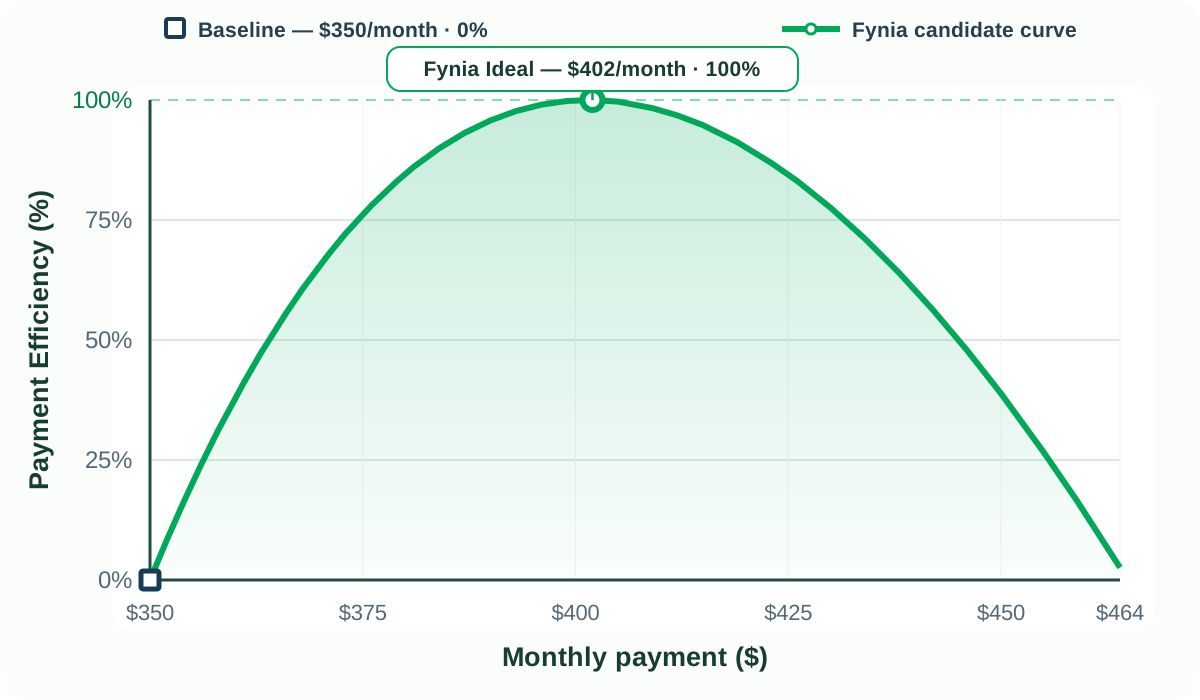
The Ideal is the strongest point within Fynia's evaluated candidate-payment curve under these loan inputs. It is not a universal recommendation, affordability judgment, or guarantee that this payment is best for every borrower.
The lifetime interest saved divided by monthly-payment increase figures above are descriptive only. They are not Fynia Payment Efficiency and do not use this normalization.
Projected student loan balance over time
The balance paths separate gradually because each recurring increase directs more of every payment toward principal. Once a path reaches payoff, its graph line remains at zero only so all four series can share the same Month 0-to-116 axis.
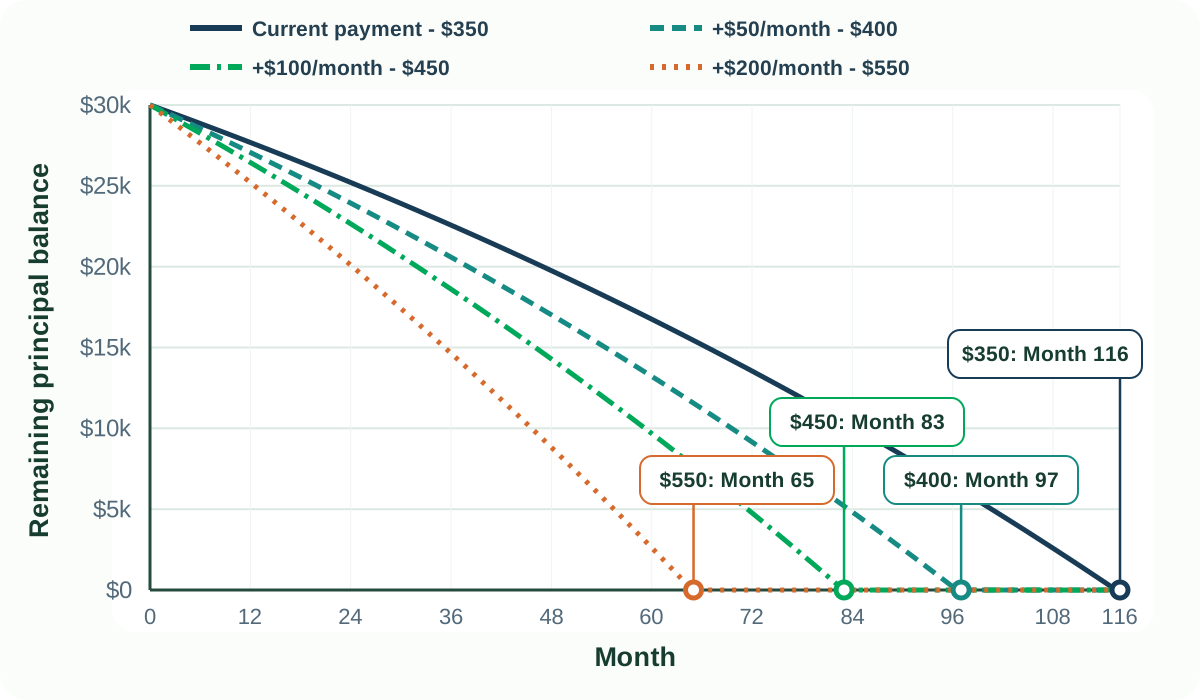
| Month | $350 | $400 | $450 | $550 |
|---|---|---|---|---|
| 0 | $30,000.00 | $30,000.00 | $30,000.00 | $30,000.00 |
| 12 | $27,681.73 | $27,063.55 | $26,445.34 | $25,208.94 |
| 24 | $25,208.21 | $23,930.43 | $22,652.61 | $20,097.02 |
| 36 | $22,569.05 | $20,587.49 | $18,605.88 | $14,642.74 |
| 48 | $19,753.14 | $17,020.64 | $14,288.13 | $8,823.18 |
| 60 | $16,748.64 | $13,214.94 | $9,681.22 | $2,613.87 |
| 72 | $13,542.92 | $9,154.35 | $4,765.77 | $0.00 |
| 84 | $10,122.50 | $4,821.82 | $0.00 | $0.00 |
| 96 | $6,473.00 | $199.14 | $0.00 | $0.00 |
| 108 | $2,579.09 | $0.00 | $0.00 | $0.00 |
| 116 | $0.00 | $0.00 | $0.00 | $0.00 |
How does the modeled interest rate change the comparison?
To test sensitivity, the model compares $350 with $450 while holding the $30,000 starting balance and all other assumptions constant. Only the annual modeled rate changes.
| Modeled annual rate | $350 total interest | $450 total interest | Interest saved | $350 payoff | $450 payoff | Months saved |
|---|---|---|---|---|---|---|
| 4.00% | $5,388.45 | $3,984.17 | $1,404.28 | 102 months | 76 months | 26 |
| 6.50% | $10,439.33 | $7,321.28 | $3,118.05 | 116 months | 83 months | 33 |
| 9.00% | $18,229.12 | $11,744.81 | $6,484.31 | 138 months | 93 months | 45 |
In this controlled example, the interest savings and payoff-month reduction from paying $450 instead of $350 were larger at higher modeled annual rates. This observed pattern is not a universal rule for every student loan.
Can a smaller extra student loan payment still help?
Yes, under this model. The $50 monthly increase saves $1,839.11 and 19 months relative to the current path. A smaller increase may also be easier to sustain than a $100 or $200 commitment.
The best comparison is not simply the highest payment versus doing nothing. Compare several amounts, preserve room for required expenses, and decide whether the next increase creates enough projected benefit for the additional monthly commitment. For a general framework, see how much extra to pay each month.
When the loan math is not the whole decision
A higher recurring payment can improve the modeled loan path while still being a poor fit for a borrower's cash flow. Emergency reserves, higher-cost obligations, employer benefits, and near-term expenses can matter more than the projected saving.
Federal program benefits can also change the decision. Paying extra may reduce a balance that could otherwise qualify for forgiveness, and extra payments do not necessarily accelerate qualifying-payment requirements. Review whether paying more fits your budget rather than treating the modeled interest total as a complete financial answer.
Federal and private student loans can behave differently
Federal student loans
Federal loans can include income-driven repayment, forgiveness, deferment, forbearance, and program-specific payment rules that this model does not evaluate. Borrowers pursuing PSLF or another forgiveness path should verify current eligibility and payment rules before changing their strategy.
Federal repayment and forgiveness rules can change, so borrowers should verify current program terms directly on StudentAid.gov.
Private student loans
A private fixed-rate loan may remove some of the federal-program considerations discussed above, but its actual interest accrual, payment allocation, and servicing rules can still differ from this model.
Make sure the extra amount is applied as expected
Before relying on the projected savings, confirm how extra loan payments are applied. A payment may first satisfy fees or accrued interest, and a servicer may advance the due date or use paid-ahead status.
- Ask whether the amount above the required payment will reduce principal.
- Confirm whether the next due date or required payment will change.
- Review the transaction and principal balance after the payment posts.
- Keep paying on schedule if your strategy depends on a recurring monthly increase.
This article models one loan. It does not decide how money should be allocated across other balances or loan groups.
Compare your own student loan payment options
The example shows why comparing more than one increase matters. Your balance, rate, current payment, and available monthly cash may produce a different trade-off.
Use Fynia to compare your student loan payment options, or review a complete student loan payoff example before running your own report.
Frequently asked questions
How much can extra student loan payments save?
The answer depends on the balance, rate, timing, payment amount, and loan rules. In this controlled $30,000 example, adding $50, $100, or $200 per month saves $1,839.11, $3,118.05, or $4,783.85 in modeled interest.
Does paying extra on student loans reduce interest?
It can when the extra amount reduces principal on a loan that calculates future interest from the outstanding balance. Actual allocation and interest methods should be confirmed with the lender or servicer.
Is it better to pay $50 or $100 extra on a student loan?
The $100 increase produces more savings in this model, but it also requires another $50 every month. Compare the incremental outcome with the additional commitment and your budget.
Does paying extra lower my required student loan payment?
Not necessarily. This model keeps the recurring payment fixed at the selected amount and uses the higher payment to shorten payoff. Your contractual payment and due-date treatment depend on your loan and servicer.
Will extra payments shorten my student loan payoff time?
They can when the extra money reduces principal and regular payments continue. In this model, the three increases shorten payoff by 19, 33, and 51 months.
Should I make extra payments if I am pursuing PSLF or another forgiveness program?
Extra payments may reduce a balance that could otherwise qualify for forgiveness and generally do not shorten program requirements by themselves. Verify current rules and your eligibility on StudentAid.gov before paying extra.
Do extra payments work the same on federal and private student loans?
No universal treatment applies. Federal programs and private contracts can differ in interest accrual, benefits, allocation, and servicing. Review the terms for the specific loan.
How do I make sure an extra student loan payment is applied correctly?
Ask the servicer how it will apply the amount, provide allocation instructions when available, and verify the principal balance, transaction, payment status, and next due date after posting.
Methodology
The editorial model starts with one current fixed-rate amortizing loan, a $30,000 principal balance, a 6.50% modeled annual rate, no unpaid accrued interest, and a current payment of $350. It compares recurring payments of $350, $400, $450, and $550.
The periodic rate is the annual modeled rate divided by 12. Each month, interest is calculated on the beginning balance and rounded to cents using ROUND_HALF_UP. The payment first covers interest, the remainder reduces principal, and the cent-rounded ending balance becomes the next month's beginning balance. The final payment is adjusted exactly to reach $0.00.
The model excludes daily accrual, variable rates, fees, penalties, delinquency, deferment, forbearance, subsidies, refinancing, autopay discounts, taxes, forgiveness calculations, recasting, skipped payments, new borrowing, and allocation across other balances or loan groups.
The audit independently reconstructed 365 amortization rows with zero mismatches and confirmed 468 graph balance points. The production payoff month was the same for all four scenarios. The maximum production-versus-editorial total-interest difference was approximately 3.34 cents, so the editorial cent-rounded model was selected for publication.
Many student loans use daily simple-interest accrual. Calendar days, payment dates, posting dates, and servicing behavior can therefore make actual results differ from this controlled monthly illustration.
Educational disclaimer
This article is for educational and illustrative purposes only. It is not financial, legal, tax, or lending advice. Fynia does not determine eligibility for federal repayment or forgiveness programs. Actual results depend on your loan agreement, interest method, payment timing, lender or servicer practices, and current program rules.
Article details
Author: Fynia Research Team
Published: August 25, 2026
Last reviewed: August 25, 2026
Reading time: 12 min read
Scope: One student loan compared across four recurring monthly payment levels.