Extra loan payments do not always go directly to principal. Depending on the loan, account status, contract, payment timing, and instructions, the money may first cover fees, overdue amounts, or accrued interest. Any remaining amount may reduce principal, affect a future amount due, or receive another treatment under the lender's or servicer's rules.
That is why sending more than the required payment is only the first step. You also need to confirm how the payment was posted.
Before paying extra, review the available payment options and your loan documents. After the transaction posts, check the payment breakdown, principal balance, next due date, and next amount due. Those details help determine whether the payment produced the result you expected.
Key takeaway: An extra payment can only follow the payoff path you expect when it is applied consistently with the assumptions behind that projection.
In this guide
- What counts as an extra loan payment?
- Why payment allocation is not universal
- Where an extra payment may go
- What a principal-only payment means
- How paid-ahead status works
- How treatment may differ by loan type
- Why your balance may fall by less than expected
- How to verify that the payment was applied correctly
- A worked example using one payment under three hypothetical account conditions
- How correct application affects a payoff projection
- What to ask before paying extra
What counts as an extra loan payment?
An extra payment is money paid above the amount currently required under the normal repayment schedule.
It is important to distinguish an extra payment from several related terms.
| Payment type | What it generally means |
|---|---|
| Regular payment | The scheduled amount currently due |
| Extra payment | Money paid above the amount currently required |
| Principal-only payment | Money specifically directed toward principal, when permitted and processed that way |
| Partial payment | Less than the full amount currently due |
| Payoff payment | The amount needed to satisfy the loan completely |
A regular payment on an amortizing loan normally includes both interest and principal. Early in the repayment schedule, more of the payment may go to interest because the outstanding balance is still relatively high. As the balance falls, the interest portion generally falls and the principal portion increases.
For a deeper explanation, see how amortization splits a payment between principal and interest.
An extra payment and a partial payment are not the same thing:
An extra payment exceeds the amount due. A partial payment does not satisfy the full amount due.
That distinction matters. For example, a mortgage servicer may treat a partial payment differently from a complete periodic payment, including holding it temporarily until enough money has accumulated to satisfy a full payment.
A payoff payment is also different from the principal balance displayed online. A payoff amount may include interest through the intended payoff date and other amounts required to close the account completely.
Lender versus servicer
The lender is generally the entity that originally provided or currently owns the credit. The servicer manages functions such as billing, collecting payments, maintaining account records, and answering payment questions.
Sometimes the same company performs both roles. Sometimes it does not. In this guide, lender or servicer refers to the party responsible for processing and recording the payment.
There is no universal payment-allocation order
A common assumption is that every dollar paid above the scheduled amount automatically reduces principal.
That may happen, but it should not be assumed without reviewing the rules for the specific account.
Payment application can depend on:
- the loan agreement;
- the type of loan;
- whether the account is current or delinquent;
- fees or overdue amounts;
- the method used to accrue interest;
- the date on which the payment posts;
- whether the borrower submitted special instructions;
- the lender's or servicer's processing rules;
- whether several loans or loan groups are billed together.
For some auto and student loans, official guidance describes a general sequence in which payments may cover fees, then interest, and finally principal. That general description is useful, but it should not be treated as a universal rule for every installment loan.
The most reliable sources for your own account are:
- your promissory note or loan agreement;
- the lender's payment instructions;
- the payment portal;
- your monthly statement and transaction history;
- written confirmation from the lender or servicer.
Where can an extra loan payment go?
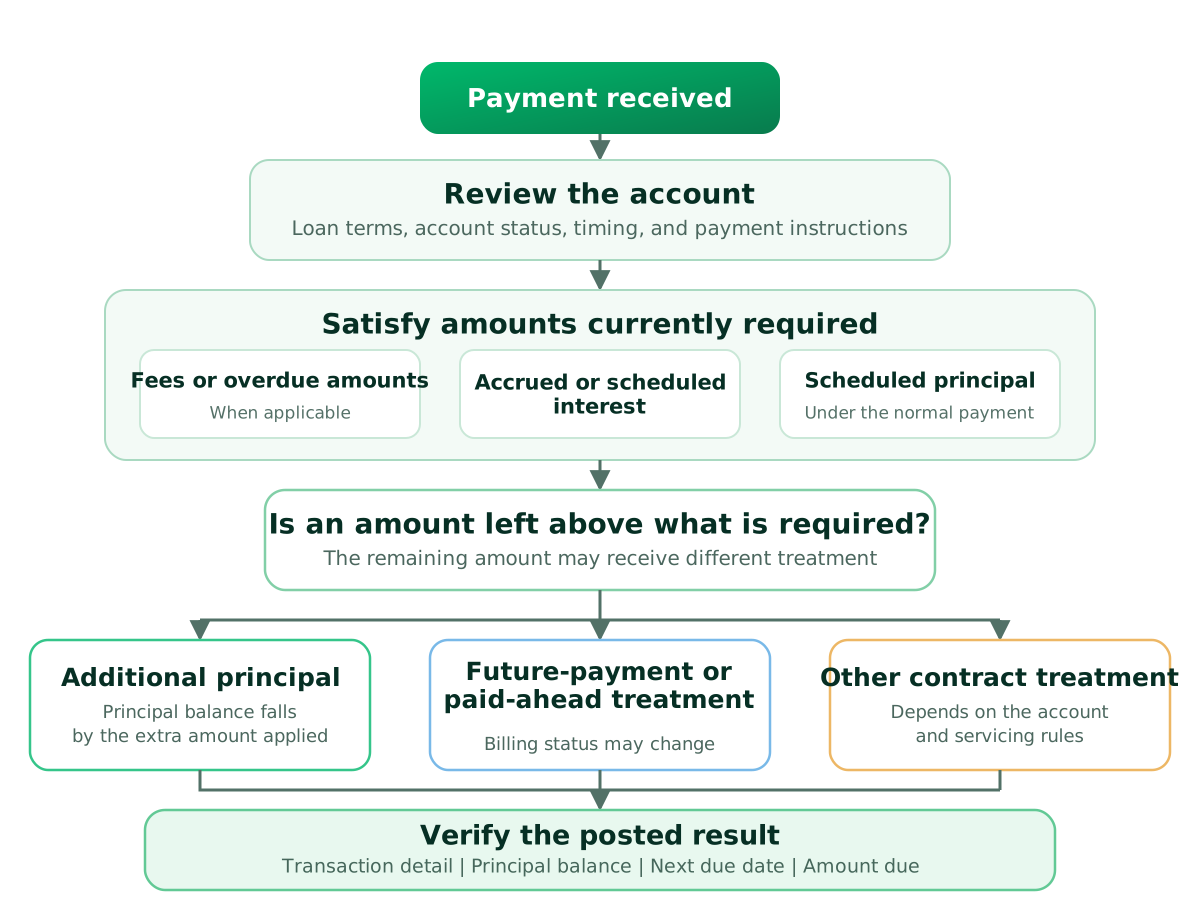
The diagram should be interpreted as a decision process, not as a fixed contractual sequence that applies to all loans.
Fees or overdue amounts
If the account has late fees, returned-payment charges, collection costs, or other amounts currently due, some of the payment may be used to satisfy those obligations before it produces an additional reduction in principal.
The exact charges depend on the agreement and account history. The difference between the amount sent and the scheduled payment should not automatically be treated as additional principal without checking the posted transaction.
Accrued or scheduled interest
Interest may have accumulated since the previous payment or through the date on which the new payment posts.
For many simple-interest loans, interest is based on the outstanding balance and may accrue daily or monthly. A payment commonly covers the interest currently owed before the remaining amount reduces principal.
The amount reaching principal may therefore vary with:
- the number of days since the previous payment;
- the posting date;
- the current principal balance;
- the interest-calculation method;
- unpaid interest from earlier periods.
Scheduled principal
Part of the required payment may already be scheduled to reduce principal.
Suppose a $350 regular payment contains:
- $112.50 of current interest;
- $237.50 of scheduled principal.
The $237.50 is not an extra payment. It is the normal principal portion of the scheduled installment.
Additional principal
Once currently required amounts have been satisfied, the remaining money may reduce the outstanding principal balance.
On loans where interest is calculated from the outstanding balance, reducing principal can lower the amount on which future interest is calculated. Learn more about how extra payments reduce future interest.
The result still depends on the loan structure. For example, a simple-interest auto loan and a precomputed-interest auto loan may not respond to extra payments in the same way.
A future-payment credit or advanced due date
In some servicing systems, paying more than the amount currently due may also advance the next due date or reduce a future amount due.
This is commonly called paid-ahead status in federal student-loan servicing. Depending on the servicer's rules and the size of the overpayment, the next statement may show a smaller amount due or even $0 due.
An advanced due date does not, by itself, reveal how much principal was reduced. You must inspect both:
- the financial allocation of the transaction; and
- the account's billing status.
What is a principal-only payment?
A principal-only payment is an amount specifically intended to reduce principal rather than satisfy a future scheduled installment.
The name of the option varies. A lender or servicer may use terms such as:
- principal-only payment;
- additional principal;
- principal curtailment;
- principal reduction;
- apply excess to principal;
- special payment instructions.
Selecting one of these options may help communicate your intent, but the actual treatment still depends on the agreement and payment system.
A principal-only payment should not automatically be treated as a substitute for the regular amount due. Depending on the loan, the borrower may need to make the scheduled payment separately.
Mortgage example
Fannie Mae's servicing guidance uses the term principal curtailment. For a current mortgage loan subject to that guidance, an additional amount identified as a principal curtailment receives specific treatment. When it is submitted with a scheduled monthly payment, the regular payment is processed and the curtailment is then applied under the applicable rules.
Those requirements should not be generalized to every mortgage in the United States.
A large principal reduction also does not necessarily lower the contractual monthly payment. A separate recast or re-amortization process may be available for some mortgages, subject to the loan's eligibility requirements and the servicer's procedures.
What does paid-ahead status mean?
Paid-ahead status generally means that an overpayment has satisfied some or all of a future scheduled amount, causing the next due date to move forward or the next bill to show a reduced amount.
This concept is particularly common in federal student-loan servicing.
The most important distinction
Paid-ahead status describes billing status, while principal application describes where the money went. Both can occur at the same time.
A payment may reduce principal and also cause the account to appear paid ahead.
Check:
- how much went to interest;
- how much went to principal;
- whether the due date moved;
- whether the next amount due changed;
- whether automatic payments will continue;
- whether program-specific rules or borrower benefits apply.
Do not decide to skip the next payment solely because the due date moved. Interest may continue to accrue on the remaining balance, and payment behavior may interact with other loan-specific rules.
How extra payments may differ by loan type
The phrase "extra payment" can describe different operational processes across loan products.
| Loan type | What to check | Common source of confusion |
|---|---|---|
| Mortgage | Principal-curtailment instructions, escrow, account status, and recast rules | Assuming extra principal automatically lowers the required monthly payment |
| Auto loan | Fees, accrued interest, simple versus precomputed interest, and prepayment terms | Assuming every dollar over the payment immediately reduces principal |
| Personal loan | Contract, portal instructions, payment allocation, and penalties | Assuming all lenders follow the same procedure |
| Student loan | Loan groups, payment directions, accrued interest, and paid-ahead status | The overpayment being allocated differently from the borrower's intention |
Mortgage
A mortgage payment may contain principal, interest, and escrow for taxes or insurance. Money intended for additional principal should be distinguished from the regular periodic payment.
Mortgage borrowers should determine:
- whether the servicer provides a principal-curtailment option;
- whether the loan is current;
- whether escrow is handled separately;
- whether a large principal reduction qualifies for a recast;
- whether any prepayment restriction applies.
Not all mortgages have a prepayment penalty. When one exists, it may apply only under specific circumstances, such as paying off the entire balance or making a large payment within a defined period.
Auto loan
For many auto loans, payments generally cover currently due fees and interest before reducing principal.
The interest method is especially important. Simple-interest loans calculate interest from the outstanding balance. Precomputed-interest loans calculate the financing cost differently, so extra payments may not produce the same reduction in principal or total interest.
Before paying more, review the agreement and compare extra auto loan payment options.
Personal loan
Personal-loan practices vary by lender and contract.
Confirm:
- whether the payment portal offers a principal-only option;
- whether the extra amount will affect the next due date;
- whether interest accrues daily or monthly;
- whether any prepayment charge applies;
- whether separate instructions are required;
- how the transaction will appear on the statement.
A general rule from a mortgage, auto loan, or student loan should not automatically be applied to a personal loan.
Student loan
Student-loan payment application may involve several individual loans or loan groups under one servicer.
Payments may be divided among:
- fees;
- accrued interest;
- principal;
- multiple loan groups;
- loans with different interest rates.
Federal servicers may also use paid-ahead status and special allocation rules. Income-driven repayment, forgiveness programs, subsidies, and other borrower benefits can add further complexity.
This article does not attempt to optimize federal forgiveness or income-driven repayment strategies. Borrowers using those programs should review current official instructions before changing their payment behavior.
For a separate one-loan illustration, compare how extra student loan payments affect payoff outcomes across four recurring monthly amounts.
Why your balance may fall by less than the extra amount
Suppose your regular payment is $350 and you submit $700.
It may be tempting to expect the principal balance to fall by the full $700. That generally will not happen because part of the payment may cover interest and other amounts currently due.
Your principal balance may fall by less than expected because of:
- current-period interest;
- previously unpaid interest;
- late or account fees;
- past-due amounts;
- payment instructions that were not recognized;
- allocation across several loans or loan groups;
- a posting delay;
- a precomputed-interest structure;
- confusion between principal balance and payoff amount.
A smaller-than-expected principal reduction does not automatically prove that the lender or servicer made an error. First compare the transaction with the agreement, payment instructions, and account history.
How to tell whether an extra payment was applied correctly
Do not look only at the next due date. Use a complete verification process.
Before paying
- Record the current principal balance.
- Confirm the regular amount due.
- Check for fees, overdue amounts, or outstanding interest.
- Review the loan agreement and prepayment terms.
- Look for an additional-principal or principal-only option.
- Ask whether the payment will advance the next due date.
- Confirm whether special instructions can be submitted once or permanently.
After paying
- Save the payment confirmation.
- Wait until the transaction has fully posted.
- Review the transaction detail, not only the account summary.
- Identify amounts applied to fees, interest, principal, and any other category.
- Compare the new principal balance with the previous balance.
- Review the next due date and amount due.
- Confirm which loan or loan group received the excess.
- Save any written instruction or secure message.
- Contact the lender or servicer when the result is unclear.
Verification rule: Check the principal balance, payment breakdown, due date, and amount due together. No single field tells the whole story.
Worked example: one $700 payment under three hypothetical account conditions
Consider a fixed-rate amortizing installment loan with these terms:
| Input | Amount |
|---|---|
| Principal balance before payment | $15,000.00 |
| Annual interest rate | 9.00% |
| Monthly interest rate | 0.75% |
| Scheduled monthly payment | $350.00 |
| One-time extra amount | $350.00 |
| Total payment submitted | $700.00 |
For clarity, this example assumes:
- interest is calculated monthly;
- the payment is made on the scheduled due date;
- the interest rate is fixed;
- there is no escrow;
- there is no prepayment penalty;
- monetary values are rounded to cents;
- the loan is not a precomputed-interest loan;
- the borrower continues paying $350 in future months.
The scenarios use different account conditions or servicing assumptions. They are not three selectable outcomes guaranteed under one loan agreement.
Step 1: calculate the current-period interest
$15,000.00 × 9% ÷ 12 = $112.50
The regular $350 payment would contain:
| Regular-payment component | Amount |
|---|---|
| Current-period interest | $112.50 |
| Scheduled principal | $237.50 |
| Total scheduled payment | $350.00 |
After the regular $350 payment, the principal balance would fall from $15,000.00 to $14,762.50.
The borrower sends an additional $350, creating a total payment of $700.
Scenario A — Applied to additional principal
Assume:
- the account is current;
- no fees are due;
- no past-due interest exists;
- the extra $350 is applied to principal;
- the next due date remains unchanged.
| Application | Amount |
|---|---|
| Fees | $0.00 |
| Past-due interest | $0.00 |
| Current interest | $112.50 |
| Scheduled principal | $237.50 |
| Additional principal | $350.00 |
| Total principal applied | $587.50 |
| Ending principal balance | $14,412.50 |
This is the clean principal-reduction scenario.
Scenario B — Principal reduced and the account also shows paid-ahead status
Assume the financial allocation is identical to Scenario A:
| Application | Amount |
|---|---|
| Fees | $0.00 |
| Past-due interest | $0.00 |
| Current interest | $112.50 |
| Total principal applied | $587.50 |
| Ending principal balance | $14,412.50 |
The difference is operational:
- the account also shows that the next due date advanced by one month; or
- the next statement shows a reduced or $0 amount due.
If the borrower continues paying $350 every month, Scenarios A and B follow the same amortization path in this illustration. The billing display does not alter the mathematical schedule because the borrower does not skip a later payment.
The lesson is not that paid-ahead status is inherently beneficial or harmful. The lesson is that principal application and billing status are separate facts that must both be verified.
Scenario C — Fees and previously unpaid interest are satisfied first
Now assume the account has:
| Additional amount due | Amount |
|---|---|
| Late or account fee | $40.00 |
| Previously unpaid interest | $60.00 |
| Current-period interest | $112.50 |
The total applied before principal is:
$40.00 + $60.00 + $112.50 = $212.50
That leaves:
$700.00 − $212.50 = $487.50
to reduce principal.
| Application | Amount |
|---|---|
| Fees | $40.00 |
| Previously unpaid interest | $60.00 |
| Current interest | $112.50 |
| Total principal applied | $487.50 |
| Ending principal balance | $14,512.50 |
Scenario C reduces principal by $100 less than Scenarios A and B:
$587.50 − $487.50 = $100.00
That difference equals the $40 fee plus $60 of previously unpaid interest.
This simplified scenario isolates those two amounts to show their immediate effect. A real delinquent account may include other past-due amounts, including past-due principal, and may follow a different allocation process.
One payment, three hypothetical statement results
These scenarios represent different account conditions or servicing assumptions. They are not three outcomes guaranteed to be available under the same loan agreement.
Scenario A
Applied to additional principal
- Fees
- $0.00
- Previously unpaid interest
- $0.00
- Current interest
- $112.50
- Principal applied
- $587.50
- Ending principal balance
- $14,412.50
- Due-date treatment
- Unchanged
Main lesson: Extra reaches principal.
Scenario B
Principal reduced and paid-ahead status shown
- Fees
- $0.00
- Previously unpaid interest
- $0.00
- Current interest
- $112.50
- Principal applied
- $587.50
- Ending principal balance
- $14,412.50
- Due-date treatment
- Advanced hypothetically
Main lesson: Check principal and billing status separately.
Scenario C
Fees and previously unpaid interest satisfied first
- Fees
- $40.00
- Previously unpaid interest
- $60.00
- Current interest
- $112.50
- Principal applied
- $487.50
- Ending principal balance
- $14,512.50
- Due-date treatment
- Must be confirmed
Main lesson: Other obligations reduce the principal impact.
| Result from the same $700 payment | Scenario A | Scenario B | Scenario C |
|---|---|---|---|
| Fees | $0.00 | $0.00 | $40.00 |
| Previously unpaid interest | $0.00 | $0.00 | $60.00 |
| Current interest | $112.50 | $112.50 | $112.50 |
| Principal applied | $587.50 | $587.50 | $487.50 |
| Ending principal balance | $14,412.50 | $14,412.50 | $14,512.50 |
| Due-date treatment | Unchanged | Advanced hypothetically | Must be confirmed |
| Main lesson | Extra reaches principal | Check principal and billing status separately | Other obligations reduce the principal impact |
These scenarios are illustrative. They represent different account conditions or servicing assumptions, not three outcomes guaranteed to be available under the same loan agreement.
How correct application affects a payoff projection
A payoff projection assumes that payments follow the modeled amortization path.
For the same $15,000 loan, compare:
Baseline
- $350 paid every month;
- no one-time extra payment.
One-time principal reduction
- $700 paid in the first month;
- $350 paid each month afterward;
- the additional $350 reduces principal.
The audited amortization results are:
| Metric | Baseline | One-time extra | Difference |
|---|---|---|---|
| First payment | $350.00 | $700.00 | +$350.00 |
| Following monthly payment | $350.00 | $350.00 | $0.00 |
| Payoff period | 52 months | 51 months | 1 month saved |
| Final payment | $313.62 | $152.74 | — |
| Total interest | $3,163.62 | $3,002.74 | $160.88 saved |
| Total paid | $18,163.62 | $18,002.74 | $160.88 less |
| Principal repaid | $15,000.00 | $15,000.00 | $0.00 |
| Ending balance | $0.00 | $0.00 | $0.00 |
The one-time $350 principal reduction produces:
- $160.88 in projected interest savings;
- one month less until payoff.
These figures use monthly interest and cent-level rounding. A lender's actual result may differ because of daily interest, posting dates, contractual allocation rules, fees, or different rounding conventions.
The comparison shows why payment application matters. If some of the $350 expected to reach principal instead covers other obligations, the actual principal balance will not follow the modeled principal-only path.
Once you understand how your lender handles extra amounts, you can decide how much extra to pay each month and assess whether paying more on your loan is worth it.
Fynia can compare the projected effect of different monthly payments using the information entered by the user. It cannot determine or control how a lender or servicer processes a real transaction.
What to ask your lender or servicer before paying extra
Use specific questions rather than asking only, "Can I pay more?"
- Will the amount above my scheduled payment be applied to principal?
- Do I need to select or request a principal-only payment?
- Will the payment advance my next due date?
- Will it reduce my next amount due?
- Does my loan calculate interest daily or monthly?
- Does my loan use simple or precomputed interest?
- Can I submit one-time payment instructions?
- Can I create standing instructions for future extra payments?
- How will the transaction appear on my statement?
- Are there any prepayment restrictions or penalties?
- If I have multiple loans, which loan will receive the extra amount?
- Will automatic payments continue while the account is paid ahead?
Ask for written instructions or save a secure message when possible. Written records make it easier to compare the expected treatment with the posted transaction.
Verify first, then compare
An extra payment is not defined only by the amount sent. Its real effect depends on where the money goes.
A practical process is:
- confirm the amount currently due;
- identify fees, overdue amounts, and accrued interest;
- follow the lender's instructions for additional principal;
- submit the payment;
- verify the transaction and new principal balance;
- review the next due date and amount due;
- compare future payment options after understanding the actual treatment.
Sending extra money may reduce principal, future interest, and payoff time. But those projected benefits depend on the payment being applied consistently with the assumptions used in the calculation.
For additional strategies, review ways to pay off a loan faster.
Frequently asked questions
Do extra loan payments automatically go to principal?
Not necessarily. Depending on the account, the payment may first cover fees, overdue amounts, or accrued interest. The remaining amount may reduce principal or receive another treatment under the lender's rules. Review the loan agreement and posted transaction.
Can an extra payment advance my next due date?
It can in some servicing systems. This is often called paid-ahead status. An advanced due date does not, by itself, reveal whether or how much principal was reduced.
What is a principal-only payment?
It is a payment or payment component specifically directed toward reducing principal. The lender may require the borrower to select an option or submit instructions. It may not replace the regular scheduled payment.
Why did my principal balance fall by less than I paid?
Part of the payment may have covered current interest, previously unpaid interest, fees, or other required amounts. Compare the transaction breakdown with the principal balance before and after the payment.
Does paid-ahead status mean I can skip a payment?
It may mean that the current amount due is reduced or zero under the servicer's billing rules. However, interest may continue accruing, automatic payments may continue, and other program rules may matter. Confirm the consequences before changing your normal payment behavior.
Will an extra principal payment lower my required monthly payment?
Not necessarily. An extra principal payment can reduce the balance without changing the contractual monthly payment. Some mortgages may permit a separate recast or re-amortization process, subject to the loan's eligibility requirements and the servicer's rules.
Should I send an extra payment separately?
That depends on the lender's system. Some lenders allow the regular payment and additional principal to be submitted together; others provide a separate option. Follow the instructions for your loan and retain confirmation.
How can I confirm where my extra payment went?
Review the transaction detail, principal balance, interest amount, fees, next due date, and next amount due. If the result is unclear, request a payment-allocation explanation from the lender or servicer.
Methodology note
The worked example uses a hypothetical fixed-rate amortizing installment loan with:
- $15,000 starting principal;
- 9% annual interest;
- monthly interest calculation;
- $350 scheduled payment;
- a one-time $350 extra payment;
- cent-level ROUND_HALF_UP rounding;
- an adjusted final payment;
- no escrow, taxes, insurance, prepayment penalty, recast, or additional fees except where explicitly included in Scenario C.
The baseline and extra-payment schedules were calculated independently using decimal arithmetic.
Under these assumptions:
- the baseline requires 52 payments and $3,163.62 of total interest;
- applying the one-time $350 extra amount to principal reduces the schedule to 51 payments and $3,002.74 of total interest;
- the projected interest savings are $160.88.
Actual lender calculations may differ because of daily interest, payment-posting dates, contractual allocation rules, rounding practices, fees, loan groups, or a different interest method.
Sources and references
- Consumer Financial Protection Bureau, How is my student loan payment applied to my account?
- Consumer Financial Protection Bureau, Is it better to pay off the interest or principal on my auto loan?
- Consumer Financial Protection Bureau, What is amortization and how could it affect my auto loan?
- Consumer Financial Protection Bureau, What's the difference between a simple interest rate and precomputed interest on an auto loan?
- Consumer Financial Protection Bureau, Can I prepay my auto loan at any time without penalty?
- Consumer Financial Protection Bureau, What is a prepayment penalty?
- Consumer Financial Protection Bureau, What is a payoff amount and is it the same as my current balance?
- Consumer Financial Protection Bureau, My mortgage servicer refuses to accept my payment. What can I do?
- Consumer Financial Protection Bureau, Periodic statements for residential mortgage loans, Regulation Z § 1026.41
- Fannie Mae, Processing Additional Principal Payments
- Fannie Mae, Processing Mortgage Loan Payments and Payoffs
- Edfinancial Services, How Payments Are Applied
- MOHELA, How Payments Are Applied
Educational disclaimer
This article is for educational purposes and does not provide legal, tax, investment, or individualized financial advice. Loan contracts, interest methods, servicing policies, and applicable laws vary.
Review your loan documents and contact your lender or servicer before changing your payment behavior. Fynia provides projections based on the information and assumptions entered; it does not control how a lender applies a payment or guarantee a particular amount of savings.
Article details
Author: Fynia Research Team
Published: July 29, 2026
Last reviewed: July 29, 2026
Reading time: 14 min read
Scope: Educational guidance for understanding payment allocation and verifying a posted transaction.