If you are comparing a lump sum vs. extra monthly payments, the timing of the extra principal can change the result even when the total extra amount is exactly the same.
If the same extra amount is already available, and your loan calculates interest from the outstanding balance while extra payments reduce principal, applying the money earlier as a lump sum will generally reduce interest more than spreading the same dollars across later monthly payments.
In our controlled example, a $2,400 lump sum saves an additional $138.79 in interest and pays the loan off one month sooner than $200 of extra principal per month for 12 months.
That does not automatically make the lump sum the better personal financial decision. The comparison below isolates the loan mathematics. Your liquidity, whether you actually have the cash today, how your lender applies additional payments, and any prepayment terms can change the practical decision.
Key takeaway
If the same extra dollars are already available, reducing principal earlier can save more interest because the loan carries the lower balance for longer. But the mathematical winner and the best personal financial choice are not always the same thing.
At a glance
| Same $2,400 extra | Lump Sum | Monthly Extras |
|---|---|---|
| Total interest | $3,580.45 | $3,719.24 |
| Payoff | 50 months | 51 months |
| Interest saved vs baseline | $1,180.22 | $1,041.43 |
| Lump-sum advantage | $138.79 + 1 month | — |
In this guide
- What are we actually comparing?
- Why timing can change the result
- Worked example
- Lump sum vs. monthly results
- Loan balance over time
- Does the interest rate change the result?
- One extra payment a year vs. monthly extras
- What if you do not have the lump sum today?
- Liquidity and lender rules
- Differences by loan type
- When monthly extras can still make sense
- FAQ
- Methodology
- Sources and references
What are we actually comparing?
A fair comparison has to hold the amount of extra money constant.
Suppose you have $2,400 available for your loan. There are many ways you could use it, but this paper compares two specific strategies.
| Strategy | Extra-payment pattern | Total extra |
|---|---|---|
| Baseline | No additional principal | $0 |
| Lump sum | $2,400 once in Month 1 | $2,400 |
| Monthly extras | $200 in Months 1–12 | $2,400 |
The lump-sum strategy does not get more money. It simply gets the same money onto principal sooner.
Comparing a $2,400 lump sum with $300 per month for a year would not isolate timing because the second strategy would contribute $3,600. You would be changing both amount and timing.
Fair-comparison rule
Hold the extra dollars constant. What changes when only their timing changes?
Why can paying principal earlier change the result?
In an amortizing loan, each scheduled payment generally includes both interest and principal. As the outstanding principal falls, the amount on which future interest is calculated also falls under the type of amortization modeled here.
That creates the basic timing effect.
Borrower A reduces principal by the entire $2,400 near the beginning.
Borrower B reduces principal by $200 at a time over the next 12 months.
Borrower B eventually applies the same $2,400, but part of that money remains outside the loan for several months. During those months, the loan balance is higher than it would have been under the earlier lump sum.
For the underlying mechanics, see why earlier principal reduction can reduce future interest.
Worked example: $2,400 now vs. $200 per month
| Input | Value |
|---|---|
| Starting principal | $20,000.00 |
| Annual interest rate | 9.00% |
| Monthly periodic rate | 0.75% |
| Scheduled payment | $425.00 |
| Total extra dollars | $2,400.00 |
| Lump-sum strategy | $2,400 in Month 1 |
| Monthly strategy | $200 × 12 months |
For this illustration, the 9% annual interest rate is modeled as 0.75% per month. The account begins current, there are no fees or overdue amounts, no prepayment penalty is modeled, the scheduled payment remains $425, and every extra dollar is assumed to reduce principal.
The comparison begins immediately before the first scheduled payment. In Month 1, both strategies first make the same $425 scheduled payment. Only then is the extra principal applied. This prevents the lump sum from receiving an artificial extra month of interest savings.
See how amortization divides principal and interest.
Month 1 shows the timing difference immediately
Starting balance: $20,000.00
Monthly interest: $20,000 × 0.75% = $150.00
Scheduled principal: $425 − $150 = $275.00
| Strategy | Scheduled principal | Extra principal | Ending balance |
|---|---|---|---|
| Baseline | $275.00 | $0.00 | $19,725.00 |
| Lump Sum | $275.00 | $2,400.00 | $17,325.00 |
| Monthly Extras | $275.00 | $200.00 | $19,525.00 |
The lump-sum borrower starts Month 2 owing $2,200 less than the borrower using monthly extras.
But the gap does not remain $2,200. The monthly strategy continues contributing $200 each month and gradually catches up in total extra principal. The meaningful question is how much the earlier reduction changes interest and payoff after both strategies have contributed the same $2,400.
Lump sum vs. extra monthly payments: the results
| Metric | Baseline | Lump Sum | Monthly Extras |
|---|---|---|---|
| Starting balance | $20,000.00 | $20,000.00 | $20,000.00 |
| Scheduled payment | $425.00 | $425.00 | $425.00 |
| Total extra paid | $0.00 | $2,400.00 | $2,400.00 |
| Balance after Month 1 | $19,725.00 | $17,325.00 | $19,525.00 |
| Balance after Month 6 | $18,318.76 | $15,827.39 | $17,096.03 |
| Balance after Month 12 | $16,560.41 | $13,954.82 | $14,058.90 |
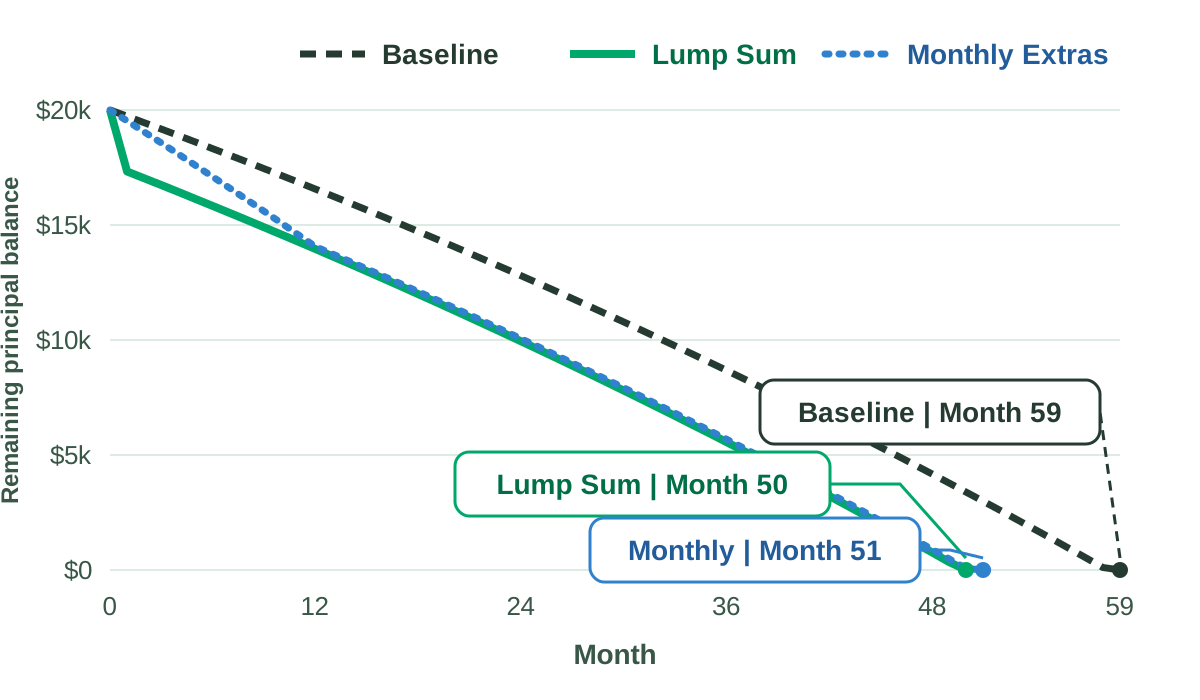
| Payoff time | 59 months | 50 months | 51 months |
| Months saved vs baseline | — | 9 | 8 |
| Final payment | $110.67 | $355.45 | $69.24 |
| Total interest | $4,760.67 | $3,580.45 | $3,719.24 |
| Interest saved vs baseline | — | $1,180.22 | $1,041.43 |
| Total paid | $24,760.67 | $23,580.45 | $23,719.24 |
Both extra-payment strategies outperform the baseline in this example.
The recurring $200 extras save $1,041.43 in interest and shorten the loan by eight months.
The earlier $2,400 lump sum saves $1,180.22 and shortens the loan by nine months.
| Lump-sum advantage | Result |
|---|---|
| Less total interest | $138.79 |
| Earlier payoff | 1 month |
| Lower balance after Month 12 | $104.08 |
| Lower total amount paid | $138.79 |
In this example, the lump-sum strategy saves an additional $138.79 in interest and pays the loan off one month sooner than spreading the same $2,400 across 12 monthly extra payments.
Why is the difference only $104.08 after 12 months?
At the end of Month 1, the lump-sum balance is $2,200 lower than the monthly-extra balance.
After Month 6, the gap has narrowed to $1,268.64. After Month 12, it is only $104.08.
That narrowing is expected. The monthly strategy is adding another $200 of principal every month. By Month 12, both borrowers have finally contributed the same total $2,400.
What the monthly strategy cannot recover is the time during which part of its $2,400 had not yet reached principal. That earlier balance reduction produces the remaining $104.08 balance advantage and ultimately the $138.79 difference in interest.
Projected loan balance over time
Does the interest rate change how much timing matters?
We repeated the same experiment at three annual interest rates while keeping the loan balance, scheduled payment, total extra dollars, and timing rules unchanged. Only the annual interest rate changed.
| Annual interest rate | Lump Sum Interest | Monthly Extra Interest | Lump-Sum Advantage | Lump Sum Payoff | Monthly Payoff | Month-12 Balance Advantage |
|---|---|---|---|---|---|---|
| 5% | $1,771.88 | $1,836.98 | $65.10 | 46 months | 46 months | $56.54 |
| 9% | $3,580.45 | $3,719.24 | $138.79 | 50 months | 51 months | $104.08 |
| 15% | $7,405.54 | $7,730.23 | $324.69 | 59 months | 60 months | $179.35 |
In this sensitivity analysis, the earlier lump sum's interest advantage increased as the modeled annual interest rate rose from 5% to 9% to 15%.
At 5%, the lump sum still saves $65.10 more interest, but both strategies finish in the same payoff month. Interest savings and payoff-month reductions should not be treated as interchangeable metrics.
This result belongs only to the scenarios modeled here, not every loan.
One extra payment a year vs. paying extra every month
A common version of the same question is whether one extra loan payment a year is better than spreading that same amount across the year. For this variation, we used the same $20,000 loan and $425 scheduled payment but reduced the extra budget to $1,200.
| Metric | $1,200 Lump Sum | $100 × 12 |
|---|---|---|
| Total extra | $1,200.00 | $1,200.00 |
| Total interest | $4,142.21 | $4,213.90 |
| Interest saved vs baseline | $618.46 | $546.77 |
| Payoff time | 54 months | 55 months |
| Earlier lump-sum advantage | $71.69 less interest and 1 month | — |
The same timing pattern appears: under these assumptions, getting the same principal reduction onto the loan earlier produces the lower interest cost. The timing of an annual payment matters; a payment near the beginning is not mathematically identical to the same payment much later.
What if you do not have the full lump sum today?
The main comparison assumes the borrower already has all $2,400 available when the experiment begins. That makes both strategies feasible: pay all $2,400 in Month 1, or retain part temporarily and release $200 per month.
If you do not have $2,400 available today and instead expect to free up $200 from income each month, an immediate $2,400 lump sum is not a real option. Your decision becomes whether to pay each extra dollar as it becomes available or accumulate it for a later payment.
Do not borrow money, create new debt, or assume you should drain other resources simply to manufacture a lump sum for the sake of winning the mathematical comparison.
The loan math does not measure liquidity
An earlier lump sum can win the interest comparison while still requiring a larger immediate use of cash.
Emergency savings can help absorb unexpected expenses or financial shocks.
Loan question: Which strategy produces the lower projected loan cost?
Personal-finance question: Is giving up the cash today appropriate for your situation?
This paper answers the first question. It does not model emergency-fund needs, investment returns, savings yields, taxes, inflation, or alternative uses for the $2,400.
The additional $138.79 should not be rewritten as a universal recommendation. Consider the broader question of whether paying more is worth it.
Confirm how your lender or servicer will apply the extra payment
Our model assumes every extra dollar goes directly to principal after the scheduled payment. Real accounts do not all behave identically.
Before relying on a projection, confirm how funds are applied, whether principal instructions are required, whether paid-ahead status changes, and whether the agreement includes a prepayment penalty.
Review how lenders and servicers may apply extra payments before changing your payment behavior.
Does the answer change by loan type?
| Loan type | What to verify |
|---|---|
| Mortgage | Confirm servicing rules, principal-curtailment treatment, and relevant prepayment terms. |
| Auto loan | Confirm the interest structure and contract. Simple-interest and precomputed-interest loans may behave differently. |
| Personal loan | Review the agreement and lender instructions rather than assuming extra principal behaves exactly like this model. |
| Student loan | Confirm current servicer rules and how additional payments affect future required payments. |
When can extra monthly payments still make sense?
The lump sum wins the controlled loan calculation, but recurring extras can still be the more practical strategy when additional cash becomes available gradually rather than all at once.
They can preserve more short-term liquidity and may be easier to sustain as part of a recurring budget, particularly when the alternative is waiting to accumulate a future lump sum before reducing principal.
In our 9% example, both strategies contribute $2,400 and both save more than $1,000 in interest versus the baseline. The additional advantage from paying the money earlier is $138.79.
Compare this timing choice with how much extra to pay each month and other ways to pay off a loan faster.
What this comparison does not mean
- A lump sum is always the best financial choice.
- Everyone should use savings to pay debt.
- Every lender applies extra payments directly to principal.
- Every loan allows unrestricted prepayment.
- A lump sum automatically reduces the contractual monthly payment.
- Monthly extra payments are a poor strategy.
- Fynia currently models or optimizes lump-sum payments.
- The example applies directly to daily-interest or precomputed-interest loans.
Controlled conclusion
Under the defined model, when the same $2,400 is already available and is applied to principal, putting it onto the loan earlier as a lump sum produces less interest than spreading those same dollars across the first 12 months.
Frequently asked questions
Is a lump-sum payment better than paying extra every month?
If the same total amount is already available and both strategies apply the money to principal, an earlier lump sum can save more interest because it reduces the balance sooner. In this example, $2,400 paid in Month 1 saves $138.79 more interest than $200 paid monthly for 12 months and finishes the loan one month earlier. That is a loan-math result, not a universal recommendation about how you should use your cash.
Why can a lump sum save more interest?
Earlier principal reduction can keep the balance lower for longer, leaving less principal on which future interest can be calculated. See how extra payments reduce interest.
What if I do not have the full lump sum available today?
Then an immediate lump sum is not a genuine alternative. Paying extra as money becomes available is a different comparison from choosing how to deploy cash you already possess.
Is one extra payment a year the same as paying extra every month?
Not necessarily. In our $1,200 mini-case, paying $1,200 in Month 1 produced $71.69 less total interest and finished one month sooner than paying $100 per month for 12 months.
Does making a lump-sum payment lower my required monthly payment?
Not automatically. In this model, the scheduled payment remains $425. The lump sum reduces principal and shortens payoff; it does not recast the loan. Actual loan terms vary.
Should an extra payment go toward principal?
This model assumes it does, but actual allocation depends on the account and instructions. Review how extra loan payments may be applied.
Does a higher interest rate make a lump sum more valuable?
In our sensitivity analysis, the incremental advantage increased from $65.10 at 5% to $138.79 at 9% and $324.69 at 15%. This is an observed result from this controlled example, not a universal rule.
Should I use savings to make a lump-sum loan payment?
The loan calculation alone cannot answer that question. A lump sum can reduce projected interest while also reducing available cash. Emergency reserves and individual circumstances matter.
Methodology
This analysis models a generic fixed-rate amortizing installment loan with a starting principal of $20,000, a modeled annual interest rate of 9%, a monthly periodic rate of 0.75%, and a scheduled payment of $425.
The baseline makes only the scheduled payment.
The lump-sum scenario makes the scheduled $425 Month-1 payment and then applies an additional $2,400 directly to principal in the same period.
The monthly-extra scenario makes the scheduled payment plus $200 of additional principal in Months 1 through 12, for exactly $2,400 total extra principal. Beginning in Month 13, it returns to the scheduled $425 payment.
Interest is calculated monthly on the beginning principal balance. Editorial calculations use decimal arithmetic, round monthly interest to the nearest cent using ROUND_HALF_UP, maintain balances to cents, and adjust the final payment exactly so that the remaining balance reaches $0 without overpayment.
The calculations exclude fees, escrow, delinquency, prepayment penalties, lender-specific posting delays, daily-interest treatment, precomputed-interest structures, taxes, investment returns, savings yields, inflation, and opportunity cost.
The published results were independently reconstructed using integer-cent accounting and cross-checked with high-precision amortization calculations. The audit confirmed every published balance, payoff period, interest total, sensitivity result, and final payment before the figures were frozen for publication.
These calculations are illustrative and separate from Fynia's current production optimizer. Fynia currently compares monthly payment options; it does not presently model the lump-sum scenarios used in this educational analysis.
Sources and references
- Consumer Financial Protection Bureau, How does paying down a mortgage work?
- Consumer Financial Protection Bureau, What is amortization and how could it affect my auto loan?
- Consumer Financial Protection Bureau, Is it better to pay off the interest or principal on my auto loan?
- Consumer Financial Protection Bureau, What's the difference between a simple interest rate and precomputed interest on an auto loan?
- Consumer Financial Protection Bureau, Your mortgage servicer must comply with federal rules
- Consumer Financial Protection Bureau, What is a prepayment penalty?
- Consumer Financial Protection Bureau, Can I prepay my loan at any time without penalty?
- Fannie Mae, Processing Additional Principal Payments
- Federal Student Aid, 5 Ways to Pay Off Your Student Loans Faster
- Consumer Financial Protection Bureau, An essential guide to building an emergency fund
Educational disclaimer
This article is for educational and illustrative purposes only. It is not financial, legal, tax, or lending advice. Actual loan results depend on your contract, interest calculation method, payment timing, fees, lender or servicer practices, applicable law, and other account-specific conditions. Before making an extra payment, confirm how your lender or servicer will apply it and whether any relevant prepayment terms apply.
Article details
Author: Fynia Research Team
Published: August 12, 2026
Last reviewed: August 12, 2026
Reading time: 14 min read
Scope: Comparing the same extra principal under two different payment-timing strategies.