
Loan term optimization is a consumer comparison process: evaluate possible repayment terms by scheduled payment, projected interest, total cost, principal reduction, and payoff timing. The goal is not to find a universal best term or optimize a lender’s pricing. It is to understand how different terms may fit a stated affordability constraint and borrowing-cost objective under consistent assumptions.
A monthly payment can be useful, but it is only one part of the comparison. Consumer guidance explains that loan-term comparisons should consider more than the monthly payment, including total loan cost and other offer details. A transparent comparison keeps the inputs consistent, identifies what the model includes, and labels results as projected rather than guaranteed.
In this guide
- What loan term optimization means
- Why the monthly payment is only one comparison point
- Inputs needed for a useful term comparison
- How to compare shorter and longer loan terms
- A practical workflow for loan term comparison
- Using Fynia to model loan-term scenarios
- Limits of loan-term comparisons
- Key takeaways for comparing loan terms
What loan term optimization means
For a consumer evaluating an installment loan, term optimization means comparing possible repayment periods against the borrower’s stated objective and constraints. It is a scenario-comparison exercise rather than a lender-pricing or approval exercise. The appropriate conclusion depends on the entered inputs and the trade-off the borrower is evaluating.
The variables that define a loan-term scenario
A loan-term scenario begins with the loan amount, interest rate or APR, repayment term, payment frequency, and relevant contract costs. Loan amount, interest rate or APR, and term are recurring inputs for comparing loan-payment scenarios. Personal-loan comparisons commonly use amount, interest rate, repayment term, monthly payment, total interest, and total cost as well. Those comparison fields are reflected in a personal-loan comparison resource.
Payment frequency matters because it determines how the amortization schedule progresses. Rate type also matters: a fixed-rate assumption makes the candidate scenarios easier to compare because the rate is held constant while the term changes. Fees and other entered costs should be identified separately from principal-and-interest calculations.
For a fuller explanation of how scheduled payments are allocated between interest and principal, see loan amortization explained.
Choosing a term versus paying a loan off faster
Selecting the original repayment term is different from deciding to make extra payments after the loan is originated. The first decision compares the contractual schedules offered for the loan. The second changes the repayment pattern after borrowing and may require separate assumptions about payment timing, application of extra amounts, and contract rules.
This paper focuses on original-term selection. A reader considering whether additional payments are worthwhile can review whether paying more on a loan is worth it or how to pay off a loan faster. Fynia may support extra-payment analysis when that topic is clearly separated from the original-term comparison, but an extra-payment scenario should not be treated as the same decision as choosing the initial term.
Why the shortest available term is not automatically the right choice
Neither the shortest nor the longest available term should be selected by a universal rule. A borrower can first identify which candidates fit the stated payment constraint, then compare the complete set of modeled outputs for those candidates. The appropriate conclusion depends on the objective, constraints, entered inputs, and contract assumptions.
Why the monthly payment is only one comparison point
Payment is visible and easy to compare, but it does not reveal the full repayment schedule. Use it as one output alongside the other modeled results rather than as a stand-alone ranking measure.
Payment affordability
The scheduled payment is a starting point for evaluating whether a scenario fits a borrower’s stated budget. Affordability should be treated as a constraint supplied by the borrower or the comparison scenario, not as a conclusion supplied by a calculator or a general rule.
A payment that falls within a stated threshold is not automatically proof that the loan is suitable. The comparison should continue with projected interest, total cost, balance progression, and payoff timing. If a candidate does not fit the stated threshold, it can be excluded from that particular comparison while the remaining candidates are still reviewed across the other outputs.
Projected interest and total cost
Projected interest is the modeled charge associated with the entered rate, balance, payment schedule, and term. Total cost depends on the scope of costs included in the model. If the model includes only principal, projected interest, and specified fees, it should not be presented as a complete statement of every possible cost under a contract.
Loan-term comparisons should consider more than the monthly payment, including total loan cost and other offer details. The comparison should distinguish projected interest from any broader total-cost measure and identify the fees or other costs included in that measure.
For background on the relationship between the rate, balance, and repayment period, see how loan interest works.
Principal reduction and repayment duration
A payment comparison should also show how much principal remains at common points in time. Amortization calculations can allocate each payment between interest and principal, producing a remaining-balance schedule. That schedule can show how modeled principal changes at the same elapsed-time checkpoint.
Repayment duration is another separate comparison point. A scheduled payoff time describes how long the modeled schedule lasts, while a remaining balance describes progress before that payoff. Looking at both helps distinguish schedule duration from balance progression.
Inputs needed for a useful term comparison
A useful comparison begins with an explicit input checklist. The inputs should be consistent when the purpose is to isolate the effect of term length, and any intentional change in another input should be labeled.
Loan amount and interest rate or APR
The starting loan amount establishes the principal balance used in the model. The interest rate or APR supplies the stated rate assumption for the scenario. When comparing terms, holding the amount and rate constant helps focus the comparison on the repayment period rather than mixing term effects with changes in borrowing amount or rate.
Loan amount, interest rate or APR, and term are recurring inputs for comparing loan-payment scenarios. If two offers have different rates, the result is no longer a pure term comparison; it is a comparison involving both term and rate.
Repayment term and payment frequency
The repayment term identifies the planned number of scheduled payment periods. Payment frequency determines how often the schedule applies interest and principal allocation. A monthly model should be compared with other monthly scenarios unless the purpose is specifically to examine a different payment schedule.
A fixed-rate installment-loan framework makes the schedules easier to compare. The model should still state its payment timing and rounding assumptions because those details can affect the final scheduled payment and the balance schedule.
Fees, insurance, taxes, and other contract terms
Fees and other contract terms may affect total cost beyond a basic principal-and-interest model. Depending on the product, a comparison may need to account for entered fees, insurance, taxes, payment rules, prepayment terms, or other disclosed items. If an item is not entered or supported, it should be identified as outside the model rather than estimated.
Loan estimates and contract disclosures may contain fees, projected payments, rate information, and other terms that can affect a comparison beyond principal and interest. The applicability of a particular disclosure depends on the loan product, so product-specific documents remain important.
Assumptions to document before comparing scenarios
Before reviewing results, document whether the rate is fixed or variable, which costs are included, how payments are timed, how currency rounding is handled, and which loan-specific terms are omitted. Also record whether the comparison changes only the repayment term or changes multiple inputs at once.
The modeled illustration in this paper uses a fixed-rate monthly framework. It uses a principal of $20,000.00, an APR of 12%, fees of $0.00, and candidate terms of 24 months, 36 months, 48 months, and 60 months. The principal, APR, fee treatment, and monthly payment frequency remain constant; term length is the comparison variable. The results are educational projections under those stated assumptions.
For the entered APR, the model uses a periodic-rate convention that derives the monthly rate by dividing the annual APR by the number of monthly payment periods in a year. This is a modeling assumption for the entered APR, not a claim that every loan contract uses the same interest-calculation convention. Scheduled payments are rounded up to the currency cent according to the approved model, and the schedule is re-amortized using that rounded payment. The final payment may be adjusted to reach zero, while periodic balances are not rounded internally. Projected total cost uses the defined included-fee scope, which here includes the shared fee of $0.00. These outputs remain modeled or projected rather than guaranteed contract results.
How to compare shorter and longer loan terms

Shorter and longer terms should be compared as different combinations of payment, projected cost, principal reduction, and timing. The purpose is to understand the trade-off, not to label one term universally optimal.
What a shorter term may change
Under comparable assumptions, a shorter term may require a higher scheduled payment because the balance is scheduled to be repaid over fewer payment periods. It may also reduce the scheduled repayment duration and result in faster modeled principal reduction. Because the balance is scheduled over fewer periods, projected interest may be lower, but the payment obligation may be more demanding.
Shorter and longer mortgage-style terms can be compared using payment, term length, interest rate, and lifetime interest or total repayment measures. The same comparison principle can be applied cautiously to other installment-loan scenarios when the product assumptions are clearly stated.
What a longer term may change
A longer term may lower the scheduled payment by spreading repayment across more periods. It may also slow modeled principal reduction, extend the scheduled payoff timeline, and increase projected interest or total borrowing cost when the other assumptions remain comparable.
These relationships describe the modeled trade-off, not a guaranteed result for every loan contract. A different rate, fee structure, payment rule, or variable-rate path could change the comparison. The longer term should therefore be reviewed for both its affordability effect and its projected cost and timing.
Compare scenarios at the same checkpoints
Side-by-side loan term comparison
| Term | Scheduled payment | Monthly payment | Projected total interest | Projected total paid | Projected total cost including fees | Payoff time | Final payment |
|---|---|---|---|---|---|---|---|
| 24 months | $941.47 | $941.47 | $2,595.27 | $22,595.27 | $22,595.27 | 24 months | $941.46 |
| 36 months | $664.29 | $664.29 | $3,914.28 | $23,914.28 | $23,914.28 | 36 months | $664.13 |
| 48 months | $526.68 | $526.68 | $5,280.44 | $25,280.44 | $25,280.44 | 48 months | $526.48 |
| 60 months | $444.89 | $444.89 | $6,693.31 | $26,693.31 | $26,693.31 | 60 months | $444.80 |
Modeled remaining balance by loan term
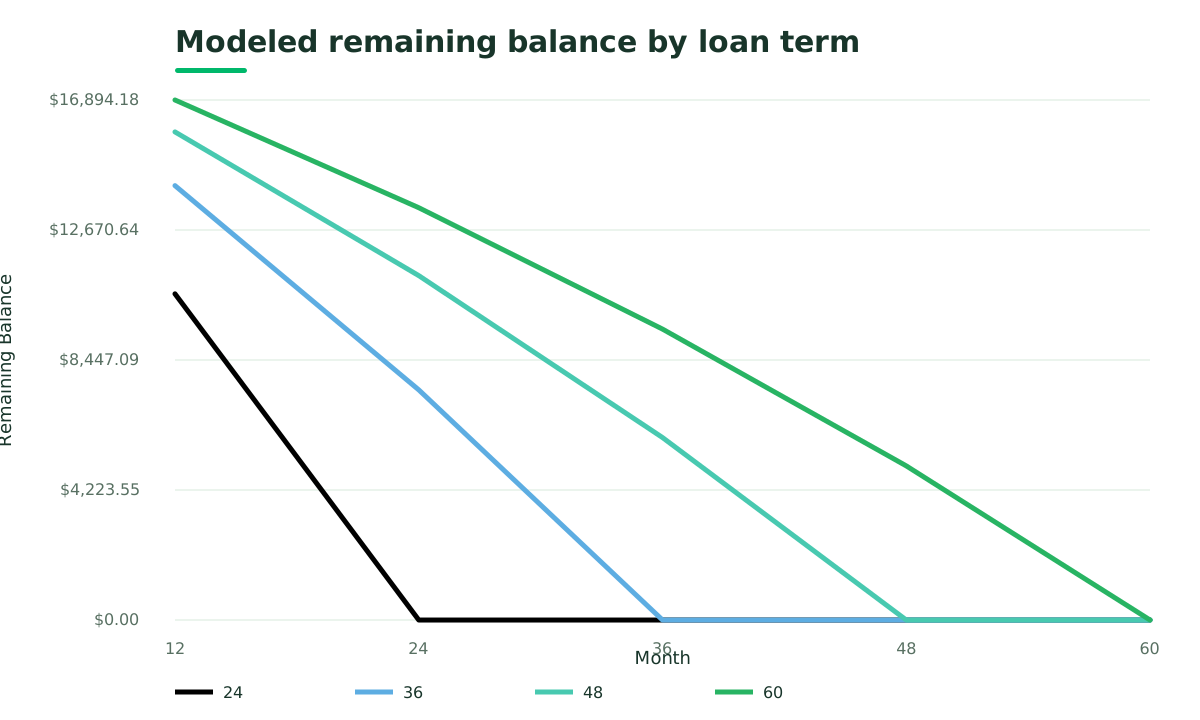
A common elapsed-time checkpoint provides another way to compare the schedules. In the modeled illustration, the projected outputs are:
| Term | Scheduled monthly payment | Final payment | Projected total interest | Projected total paid | Projected total cost including fees | Scheduled payoff |
|---|---|---|---|---|---|---|
| 24 months | $941.47 | $941.46 | $2,595.27 | $22,595.27 | $22,595.27 | 24 months |
| 36 months | $664.29 | $664.13 | $3,914.28 | $23,914.28 | $23,914.28 | 36 months |
| 48 months | $526.68 | $526.48 | $5,280.44 | $25,280.44 | $25,280.44 | 48 months |
| 60 months | $444.89 | $444.80 | $6,693.31 | $26,693.31 | $26,693.31 | 60 months |
Projected total paid and projected total cost including fees are equal in this illustration because the modeled fee is $0.00. Projected total paid reflects the modeled payments under the stated rounding and final-payment convention, while projected total cost uses the defined included-fee scope.
In this modeled example, the longer terms have lower scheduled payments and higher projected total interest and total cost. The shorter terms reach scheduled payoff sooner. Those observations describe these inputs and assumptions; they are not a personalized recommendation.
The modeled amortization comparison uses all supplied common elapsed-time checkpoints and shows zero balances after scheduled payoff where applicable:
| Term | 12 months | 24 months | 36 months | 48 months | 60 months |
|---|---|---|---|---|---|
| 24-month term | $10,596.30 | $0.00 | $0.00 | $0.00 | $0.00 |
| 36-month term | $14,111.64 | $7,476.49 | $0.00 | $0.00 | $0.00 |
| 48-month term | $15,856.88 | $11,188.31 | $5,927.65 | $0.00 | $0.00 |
| 60-month term | $16,894.18 | $13,394.47 | $9,450.90 | $5,007.20 | $0.00 |
This modeled amortization comparison adds information that the payment column does not provide. In this illustration, the shorter terms have less remaining principal at the shared 12-month checkpoint, while the longer terms preserve more of the modeled balance for later periods. The zero balances after each scheduled payoff show how the calculation terminates without carrying a negative balance.
A practical workflow for loan term comparison
A repeatable workflow helps keep the comparison focused on the borrower’s stated objective and the model’s assumptions.
Set the comparison inputs
Record the loan amount, rate or APR, candidate terms, payment frequency, rate type, and included costs. Decide whether the comparison is intended to isolate term length. If another input differs across scenarios, identify that difference before interpreting the results.
Also record any payment timing, rounding, final-payment, or product-specific assumptions. This makes it easier to distinguish a modeled schedule from the exact terms of a lender’s contract.
Create comparable scenarios
Create one scenario for each candidate term while holding the relevant comparison inputs constant. In the illustration above, the principal, APR, fees, and monthly frequency are shared across the scenarios, while the term changes.
Label scenarios clearly and avoid combining a term change with an unexplained rate, fee, or payment-frequency change. If a product feature cannot be represented, mark it as an exclusion rather than filling the gap with an estimate.
Review payment, interest, cost, balance, and payoff outputs
Use a consistent output checklist: scheduled payment, projected total interest, total cost within the defined scope, remaining balance at common checkpoints, and scheduled payoff duration. Recording the same outputs for every candidate makes the comparison auditable and prevents a scenario from being ranked by payment alone.
A side-by-side comparison can then show which candidates fit the stated payment constraint and how their modeled outputs differ. The interpretation should remain tied to the stated objective and assumptions.
Use an affordability threshold as a constraint, not a universal answer
A borrower or scenario can supply a payment threshold to exclude candidates that do not fit the stated limit. That threshold does not establish approval, eligibility, suitability, or a guaranteed outcome. It is simply a comparison constraint.
After applying the threshold, review the remaining scenarios using the same output checklist and the limitations of the entered inputs and contract terms.
Using Fynia to model loan-term scenarios
Fynia can support loan-input analysis and payment-scenario analysis for comparing possible repayment terms. Its modeled outputs depend on the information entered and the assumptions selected.
Enter the loan assumptions
The setup can identify the loan amount, rate or APR, repayment terms, payment frequency, and included fees or other supported costs. The comparison should indicate which inputs are shared and which input is being changed. For a term comparison, the term is typically the variable while the other selected assumptions remain consistent.
Review amortization and projected interest
Fynia can support amortization calculation, payment allocation, principal-reduction analysis, projected interest, and remaining-balance schedules under stated assumptions. These outputs help explain the modeled schedule and show how payment allocation changes the balance over time.
The results should be read as modeled projections. A schedule cannot represent a contract feature that was not entered or supported, and projected interest is not a guarantee of the final amount charged under every possible loan condition.
Compare modeled payoff timelines
Fynia can support scenario comparison and payoff-time projection. A reader can place candidate-term outputs side by side and review scheduled payment, projected cost, remaining balance, and scheduled payoff duration under the defined assumptions.
This comparison provides context for payment-efficiency concepts without treating any modeled term as universally best.
Interpret modeled recommendations cautiously
Fynia may support modeled payment recommendations that describe trade-offs among the entered scenarios. Such a recommendation is dependent on the entered inputs and stated assumptions. It is not personalized financial advice, an approval decision, a guarantee of savings, or proof that a scenario is optimal in the real world.
The reader should treat the recommendation as a way to organize a comparison. Contract disclosures, product features, and personal circumstances may require a different interpretation from the model’s output.
Limits of loan-term comparisons
A term comparison is only as complete as the inputs, assumptions, and contract features represented in it. The model should make exclusions visible rather than implying that omitted items have no effect.
Loan features that can change the result
Variable rates can change the payment or interest path after the initial assumption. Fees, taxes, insurance, prepayment terms, payment timing, rounding rules, and other contract details can also affect the result. A basic fixed-rate installment-loan model should not be treated as a complete representation of a product when those features are absent or unsupported.
If the comparison includes a fee, identify how it is treated in total cost. If a cost is omitted, label the exclusion. This distinction is important because projected total cost only covers the defined included-cost scope.
What this comparison does not determine
A modeled term comparison does not determine loan approval, lender pricing, eligibility, refinancing recommendations, forgiveness eligibility, guaranteed savings, or a guaranteed real-world outcome. It also does not replace product-specific disclosures or personalized financial advice.
The scope here is original repayment-term comparison for consumer installment loans. Extra-payment analysis, refinancing, forgiveness, and other repayment strategies are separate questions and should not be inferred from the term comparison.
Questions to verify in the loan documents
Before relying on a comparison, verify the rate type, APR, scheduled payment, payment frequency, fees, total-cost disclosures, prepayment terms, and any taxes or insurance relevant to the product. Confirm which costs are included in the model and which are outside it.
Loan estimates and contract disclosures may contain fees, projected payments, rate information, and other terms that can affect a comparison beyond principal and interest. The exact documents and disclosures depend on the loan product, so the model should remain labeled as a projection under stated assumptions.
Key takeaways for comparing loan terms
Loan term optimization is best understood as a structured comparison rather than a rule to select the shortest or longest repayment period. A complete review considers payment affordability, projected interest, total cost, principal reduction, remaining balance, and payoff timing together.
Use the scenario that fits the stated objective and assumptions
Start with consistent inputs, identify the affordability threshold, and compare candidate terms at the same checkpoints. Use the resulting outputs to understand the trade-off. The scenario that fits the stated objective and assumptions is not necessarily the scenario with the lowest payment or the shortest term.
Fynia can help organize loan inputs, calculate amortization, project interest and payoff timing, compare scenarios, and present modeled payment trade-offs. Those outputs remain dependent on entered information and contract assumptions. They should support an informed comparison, not be treated as guaranteed outcomes or personalized financial advice.
Sources and references
- Loan-term comparisons should consider more than the monthly payment, including total loan cost and other offer details.
- Loan amount, interest rate or APR, and term are recurring inputs for comparing loan-payment scenarios.
- Those comparison fields are reflected in a personal-loan comparison resource.
- Shorter and longer mortgage-style terms can be compared using payment, term length, interest rate, and lifetime interest or total repayment measures.
- Loan estimates and contract disclosures may contain fees, projected payments, rate information, and other terms that can affect a comparison beyond principal and interest.
Educational disclaimer
This article is for educational purposes and does not provide legal, tax, investment, or individualized financial advice. Loan contracts, interest methods, servicing policies, and applicable laws vary.
Review your loan documents and contact your lender or servicer before changing your payment behavior. Fynia provides projections based on the information and assumptions entered; it does not control how a lender applies a payment or guarantee a particular amount of savings.
Article details
Reading time: 14 min read
Scope: Compare loan terms by payment, projected interest, total cost, and payoff timing using clear, modeled scenarios—not monthly payment alone.